/00 July 2026
Replacing Human Departments With AI Swarms
(wait, what are they exactly?)
One agent can run your inbox. It cannot run a department. What agentic AI actually is, why single agents fail at multitasking, and how swarms and orchestration start doing the work of whole teams.
It plays in my pixel town: the slides on a real screen, me talking over each one. About six minutes.
/01
The deck
Every slide, and what I say over it. The bubbles are the talk. The slides are the excuse.
1 / 45Replacing Human Departments With AI Swarms - (wait, what are they exactly?)
What I say here
AI swarms. It sounds like a sci-fi film. It is really just a team of agents, each with one job.
By the end you should be able to draw one on a napkin.

2 / 45Which of these is real & Which is AI? - Which of these is real
- &
- Which is AI?
What I say here
Two videos, same bedroom, same dance. One is a real person. One is generated.
Pick one. Most rooms split close to half and half, which is the point.
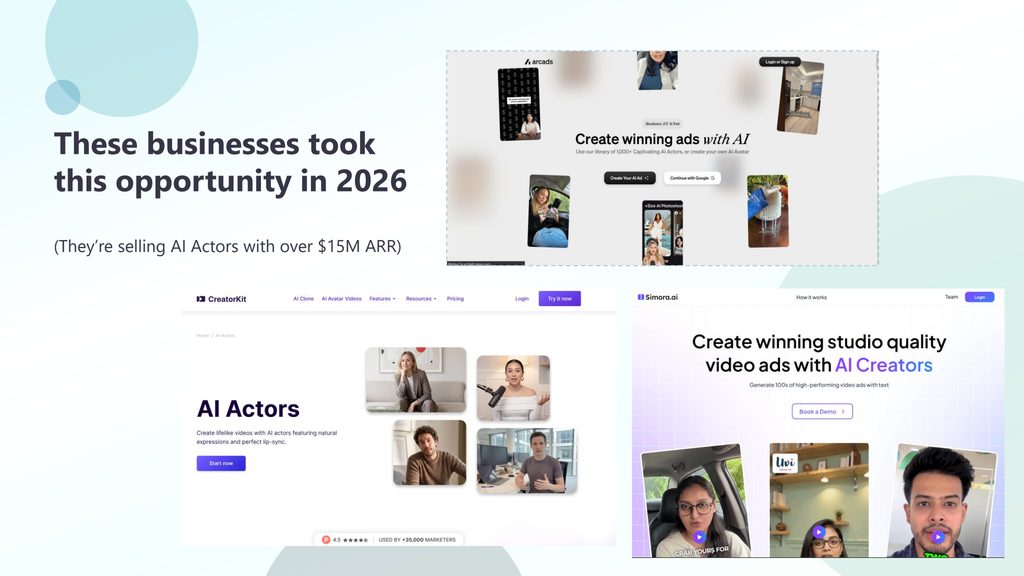
3 / 45These businesses took this opportunity in 2026 - These businesses took this opportunity in 2026
- (They're selling AI Actors with over $15M ARR)
- Create winning ads with AI
- AI Actors
- Create winning studio quality video ads with AI Creators
What I say here
And people are already selling that. AI actors for ads, over $15M ARR.
Nobody on these sites is a person. The brands buying them do not seem to mind.
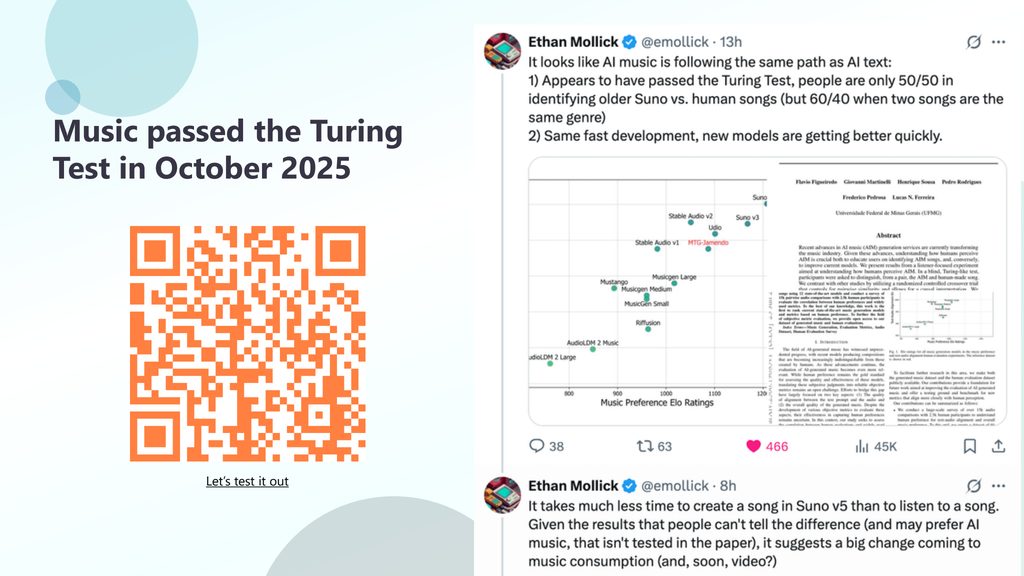
4 / 45Music passed the Turing Test in October 2025 - Music passed the Turing Test in October 2025
- Let's test it out
- Ethan Mollick: It looks like AI music is following the same path as AI text: people are only 50/50 in identifying older Suno vs. human songs (but 60/40 when two songs are the same genre)
- It takes much less time to create a song in Suno v5 than to listen to a song.
What I say here
Music went the same way. People could only tell Suno from a human about half the time.
Scan the code and try it yourself. I got it wrong more than once.
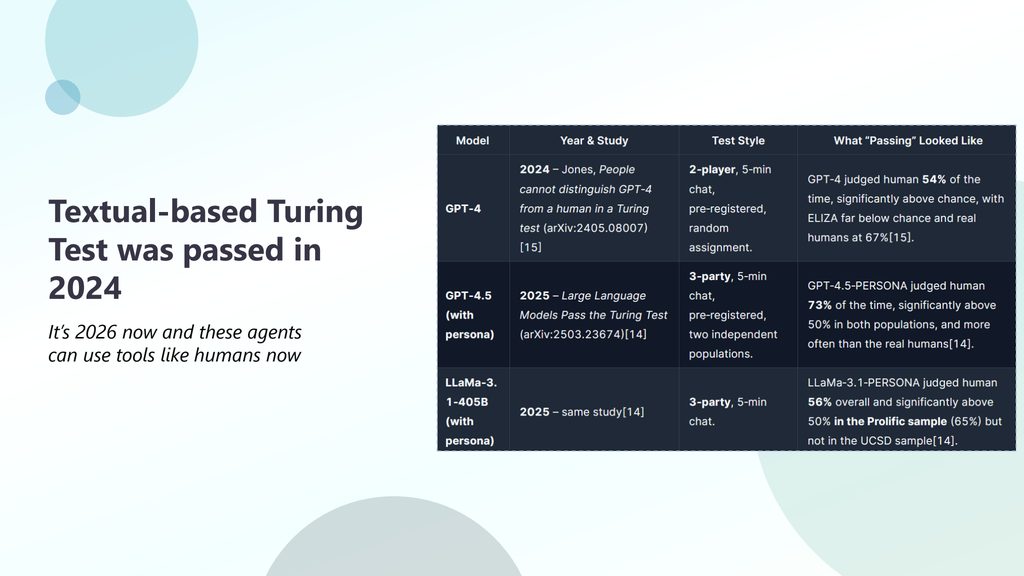
5 / 45Textual-based Turing Test was passed in 2024 - Textual-based Turing Test was passed in 2024
- It's 2026 now and these agents can use tools like humans now
- GPT-4 judged human 54% of the time
- GPT-4.5 with persona judged human 73% of the time
- LLaMa-3.1-405B with persona judged human 56% overall
What I say here
Text went first. GPT-4.5 with a persona was picked as the human 73 percent of the time. More often than the real humans.
That was talking. What changed since is that they can now use tools the way we do.
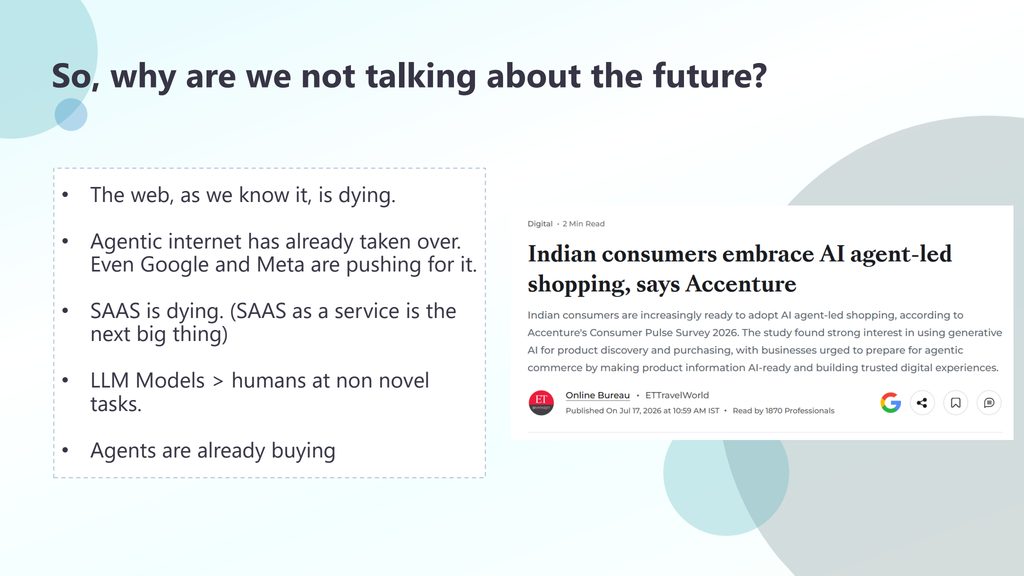
6 / 45So, why are we not talking about the future? - The web, as we know it, is dying.
- Agentic internet has already taken over. Even Google and Meta are pushing for it.
- SAAS is dying. (SAAS as a service is the next big thing)
- LLM Models > humans at non novel tasks.
- Agents are already buying
- Indian consumers embrace AI agent-led shopping, says Accenture
What I say here
So why do we still talk about AI like it is next year's problem.
The web is changing, SaaS is changing, and agents are already buying things. Even here, Accenture says Indian shoppers are ready for it.
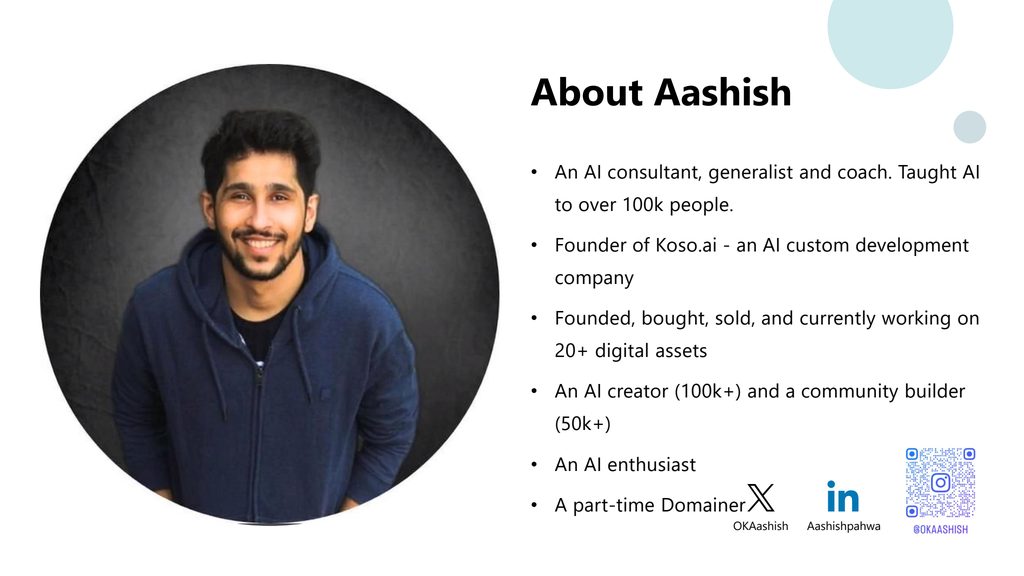
7 / 45About Aashish - An AI consultant, generalist and coach. Taught AI to over 100k people.
- Founder of Koso.ai - an AI custom development company
- Founded, bought, sold, and currently working on 20+ digital assets
- An AI creator (100k+) and a community builder (50k+)
- An AI enthusiast
- A part-time Domainer
- OKAashish, Aashishpahwa
What I say here
Quickly, me. I run Koso, we build custom AI systems. I teach AI and I make videos about it.
Most of what follows I run on my own work first, so the examples are mine.
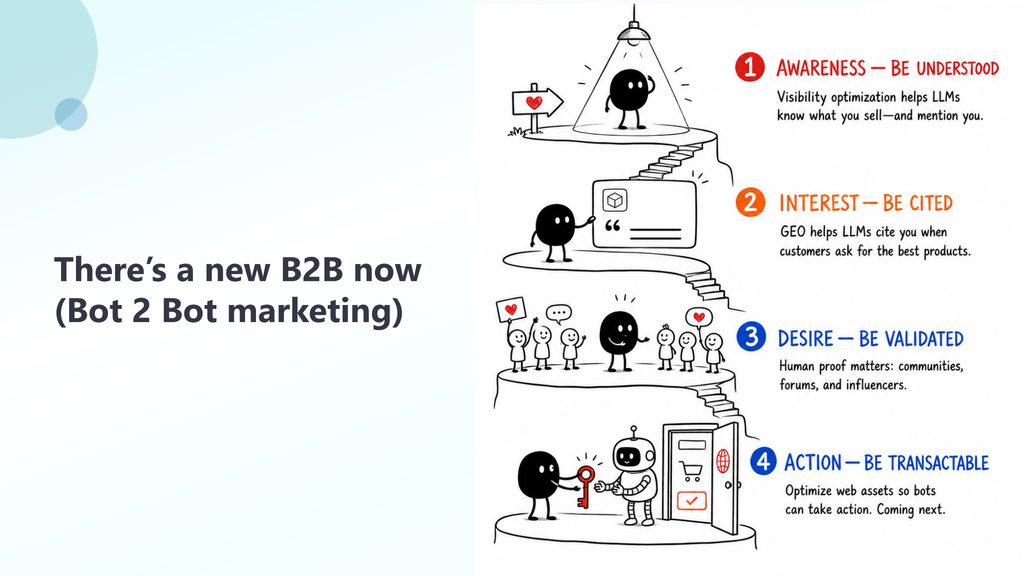
8 / 45There's a new B2B now - There's a new B2B now
- (Bot 2 Bot marketing)
- 1 Awareness: be understood. Visibility optimization helps LLMs know what you sell and mention you.
- 2 Interest: be cited. GEO helps LLMs cite you when customers ask for the best products.
- 3 Desire: be validated. Human proof matters: communities, forums, and influencers.
- 4 Action: be transactable. Optimize web assets so bots can take action. Coming next.
What I say here
There is a new B2B. Bot to bot. Your buyer's agent talks to your agent.
The funnel is still AIDA. Every stage just has a different reader now.
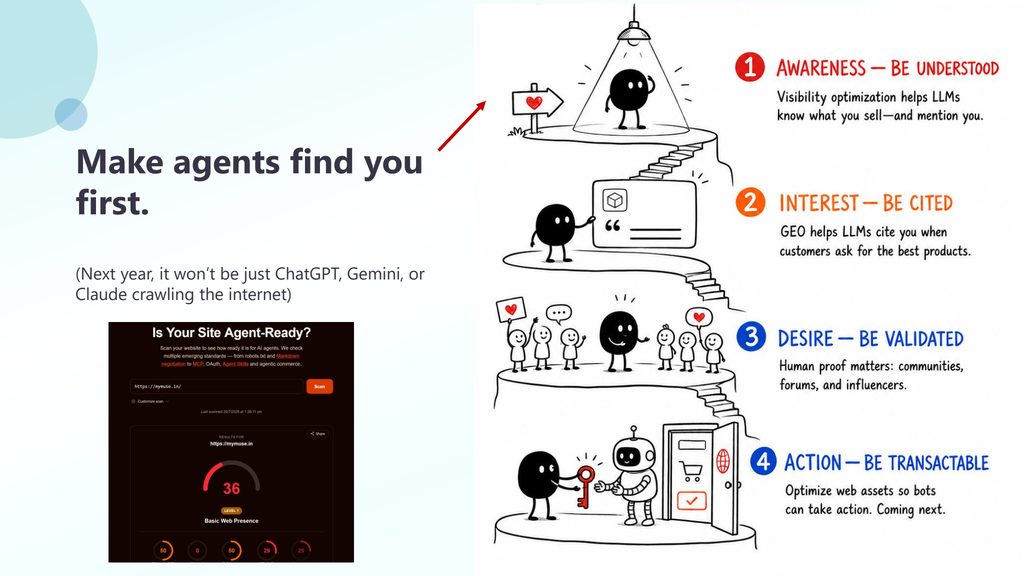
9 / 45Make agents find you first. - Make agents find you first.
- (Next year, it won't be just ChatGPT, Gemini, or Claude crawling the internet)
- Is Your Site Agent-Ready?
What I say here
Awareness first. An agent has to understand what you sell before it can recommend you.
And it will not be three crawlers for long. Every company will have its own agents reading your site.
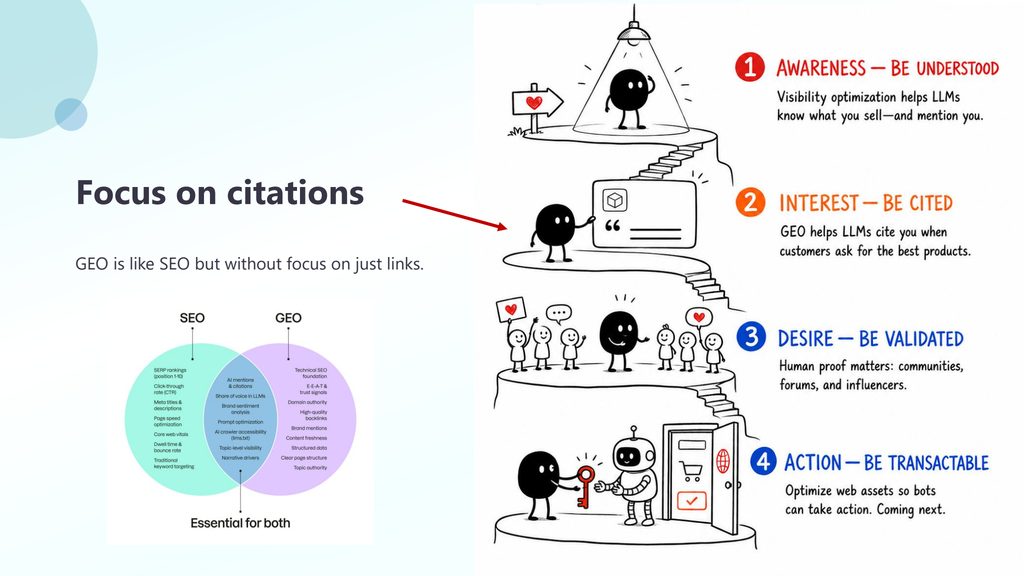
10 / 45Focus on citations - Focus on citations
- GEO is like SEO but without focus on just links.
- SEO, GEO, Essential for both
What I say here
Interest means getting cited. GEO overlaps with SEO a lot.
The difference is you are not chasing a link. You are chasing a mention inside the answer.
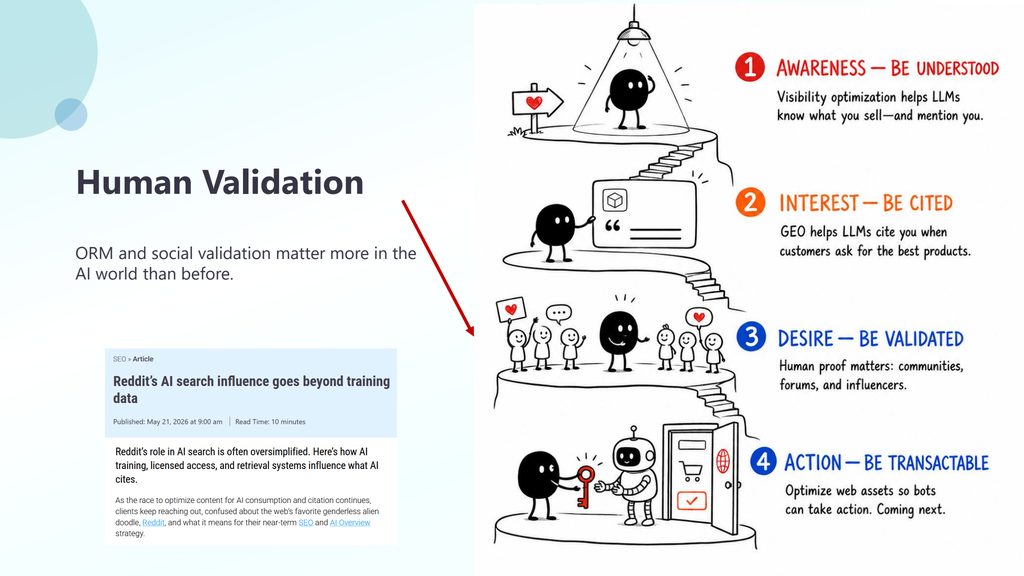
11 / 45Human Validation - Human Validation
- ORM and social validation matter more in the AI world than before.
- Reddit's AI search influence goes beyond training data
What I say here
Desire is the ironic one. The bots trust humans. Reviews, Reddit threads, creators.
Your reputation online matters more now, not less, because the model reads all of it.
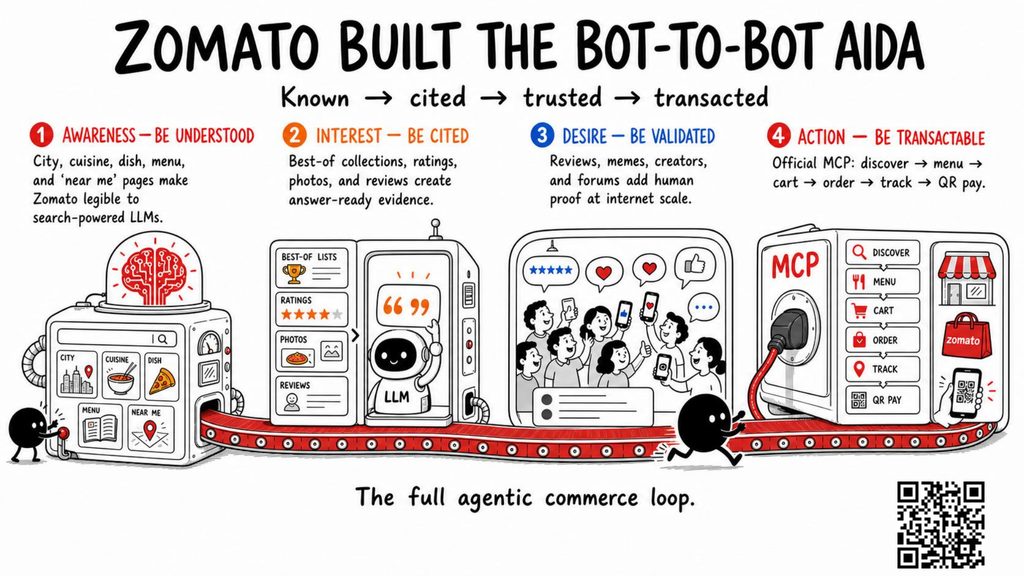
12 / 45Zomato built the bot-to-bot AIDA - Zomato built the bot-to-bot AIDA
- Known → cited → trusted → transacted
- Awareness: city, cuisine, dish, menu, and 'near me' pages make Zomato legible to search-powered LLMs
- Interest: best-of collections, ratings, photos, and reviews create answer-ready evidence
- Desire: reviews, memes, creators, and forums add human proof at internet scale
- Action: official MCP: discover → menu → cart → order → track → QR pay
- The full agentic commerce loop.
What I say here
Zomato has done all four. Pages LLMs can read, reviews they can quote, memes people share.
And the last step is an official MCP. An agent can find a restaurant, fill a cart and pay without opening the app.
13 / 45So yes, agentic commerce is (almost) here. - So yes, agentic commerce is (almost) here.
What I say here
So yes, agentic commerce is almost here. The almost is shrinking every quarter.
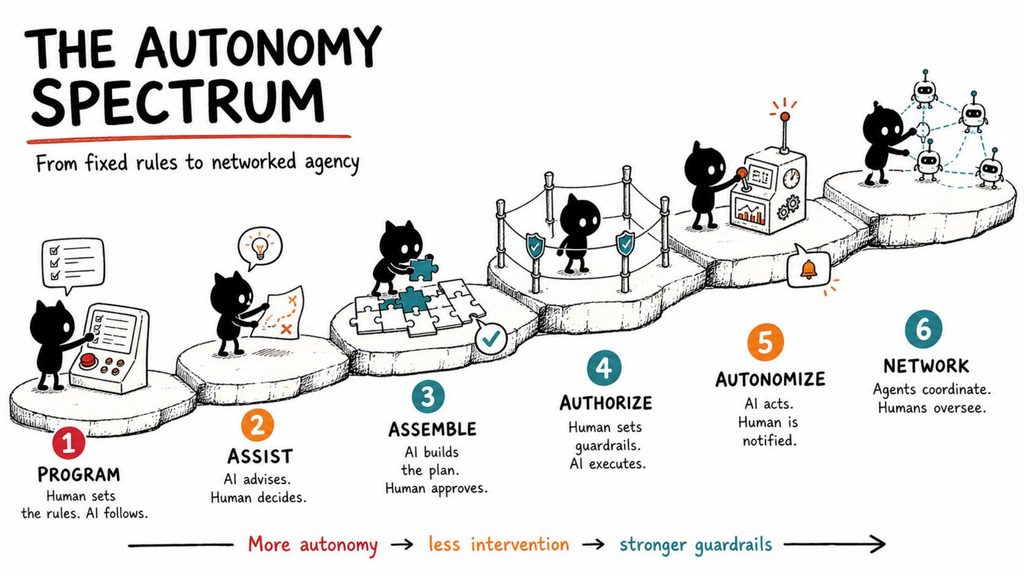
14 / 45The Autonomy Spectrum - The Autonomy Spectrum
- From fixed rules to networked agency
- 1 Program: human sets the rules. AI follows.
- 2 Assist: AI advises. Human decides.
- 3 Assemble: AI builds the plan. Human approves.
- 4 Authorize: human sets guardrails. AI executes.
- 5 Autonomize: AI acts. Human is notified.
- 6 Network: agents coordinate. Humans oversee.
- More autonomy → less intervention → stronger guardrails
What I say here
Here is the ladder. Most companies are at step two. AI advises, a human decides.
Swarms live at step six. Agents coordinate with each other and humans oversee. Notice the guardrails get stronger as you climb, not weaker.

15 / 45But that's the macro part. - But that's the macro part.
- Let's get to the individual level.
What I say here
That is the big picture. Now the part you can do something about on Monday. Your own work.
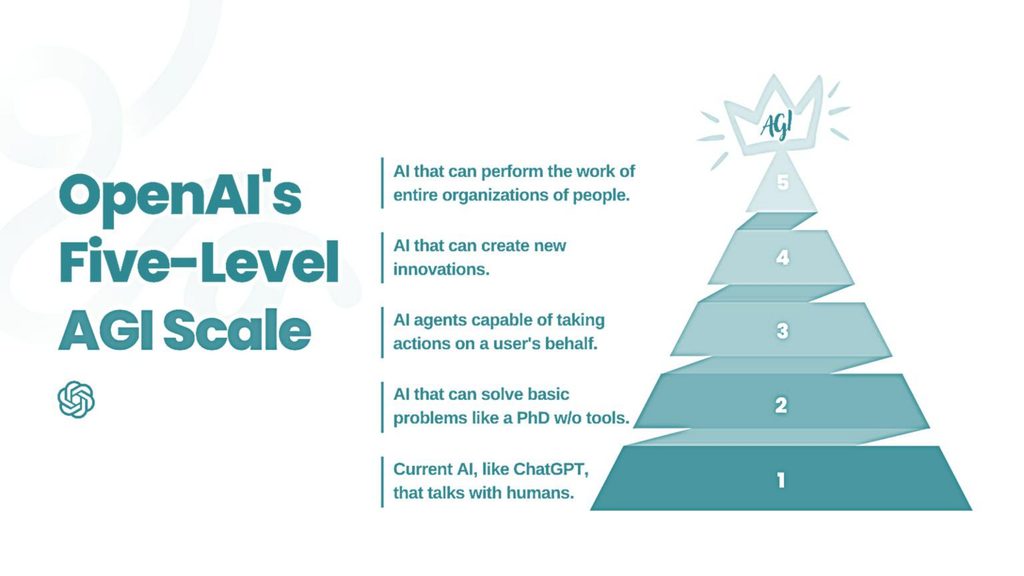
16 / 45OpenAI's Five-Level AGI Scale - OpenAI's Five-Level AGI Scale
- 1 Current AI, like ChatGPT, that talks with humans.
- 2 AI that can solve basic problems like a PhD w/o tools.
- 3 AI agents capable of taking actions on a user's behalf.
- 4 AI that can create new innovations.
- 5 AI that can perform the work of entire organizations of people.
What I say here
OpenAI's own scale. Five levels. Look at the top one. The work of entire organizations of people.
That is the same thing as this talk's title, and it is their stated goal.
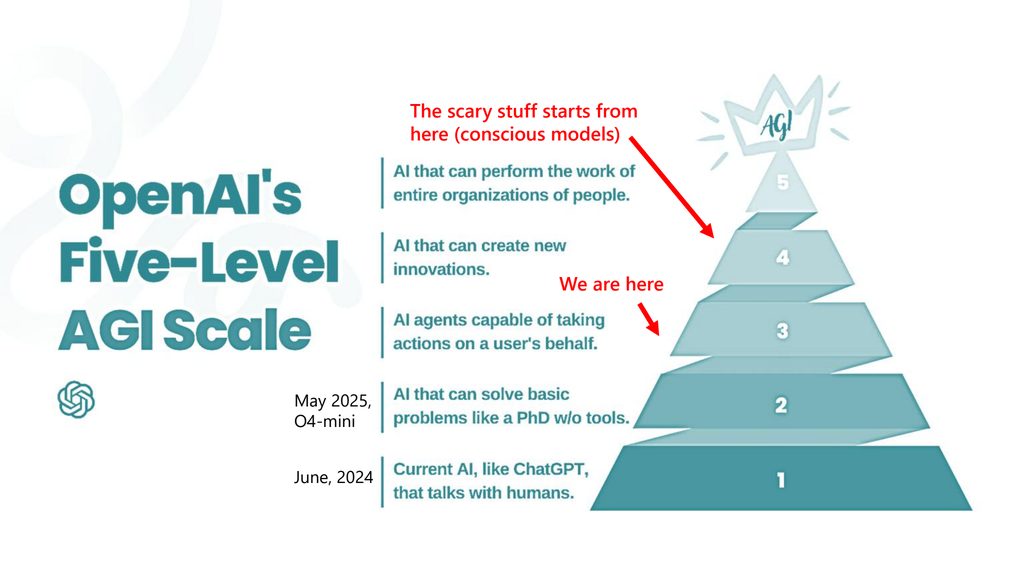
17 / 45We are here - June, 2024: level 1
- May 2025, O4-mini: level 2
- We are here: level 3
- The scary stuff starts from here (conscious models): level 4
What I say here
Level one in June 2024. Level two by May 2025. We are at three now, agents acting for us.
Level four is where it gets strange. It took under two years to climb two steps.
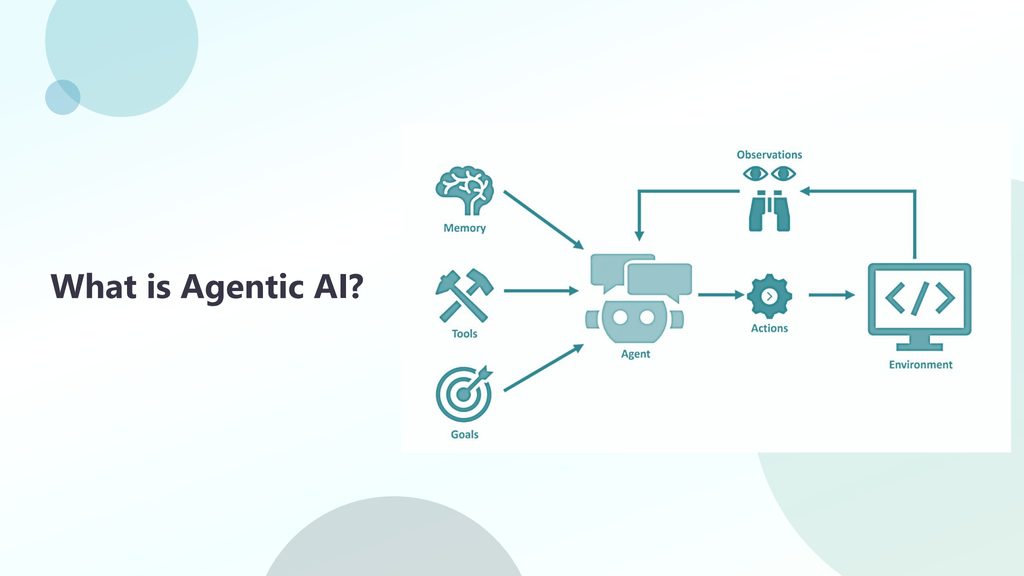
18 / 45What is Agentic AI? - What is Agentic AI?
- Memory, Tools, Goals → Agent → Actions → Environment → Observations
What I say here
So what is an agent. A model with memory, tools and a goal.
It acts on the world, looks at what happened, and goes again. That loop is the whole idea.
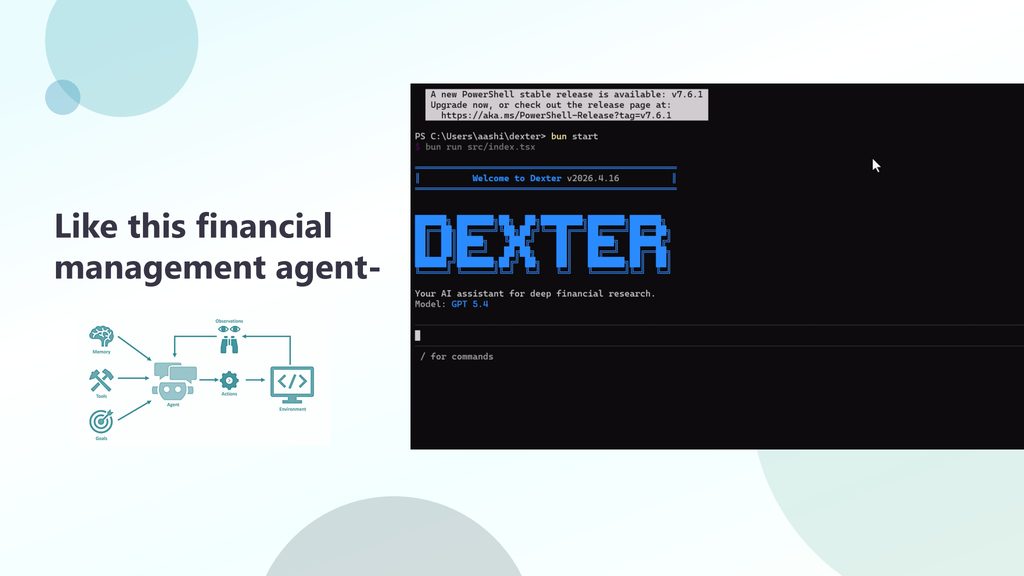
19 / 45Like this financial management agent- - Like this financial management agent-
- Dexter: your AI assistant for deep financial research.
What I say here
Like Dexter. You ask it a finance question and it goes off, pulls the data, checks itself and comes back with research.
Same loop. Goal, tools, act, look, repeat.
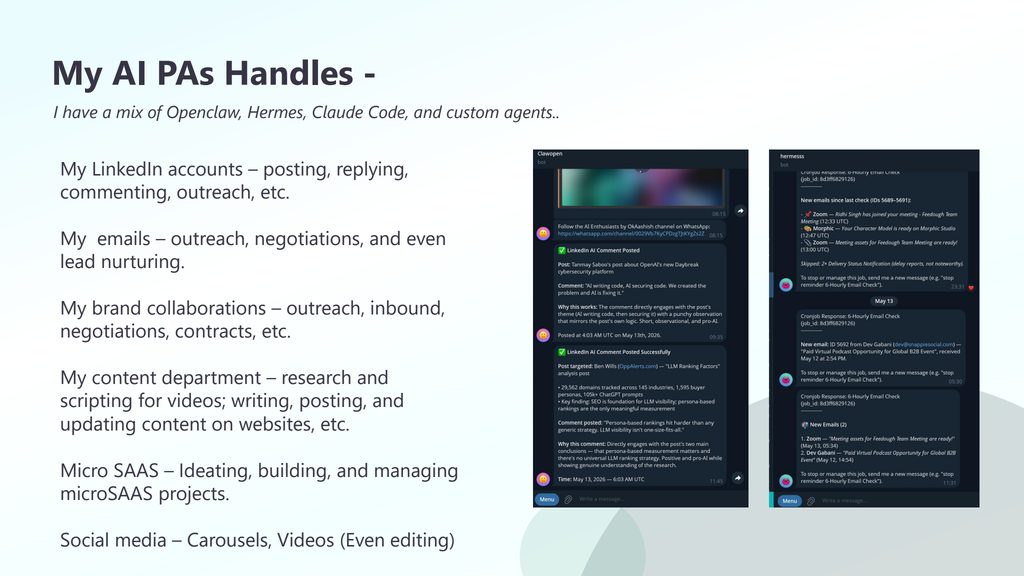
20 / 45My AI PAs Handles - - I have a mix of Openclaw, Hermes, Claude Code, and custom agents..
- My LinkedIn accounts – posting, replying, commenting, outreach, etc.
- My emails – outreach, negotiations, and even lead nurturing.
- My brand collaborations – outreach, inbound, negotiations, contracts, etc.
- My content department – research and scripting for videos; writing, posting, and updating content on websites, etc.
- Micro SAAS – Ideating, building, and managing microSAAS projects.
- Social media – Carousels, Videos (Even editing)
What I say here
This is what my agents do today. LinkedIn, email, brand deals, content, micro SaaS, even video edits.
It is not one tool. It is Openclaw, Hermes, Claude Code and some I built. Each one has a job.

21 / 45But let's understand technical stuff first. - But let's understand technical stuff first.
What I say here
Before swarms, two minutes of plumbing. I promise it is short.
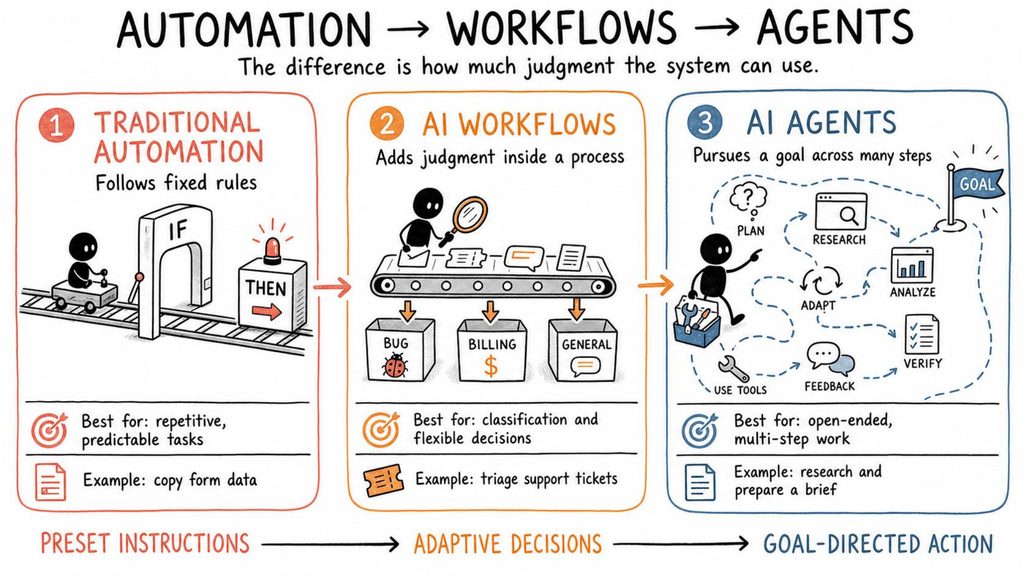
22 / 45Automation → Workflows → Agents - Automation → Workflows → Agents
- The difference is how much judgment the system can use.
- 1 Traditional automation: follows fixed rules. Best for repetitive, predictable tasks. Example: copy form data.
- 2 AI workflows: adds judgment inside a process. Best for classification and flexible decisions. Example: triage support tickets.
- 3 AI agents: pursues a goal across many steps. Best for open-ended, multi-step work. Example: research and prepare a brief.
- Preset instructions → adaptive decisions → goal-directed action
What I say here
Three things people mix up. Automation follows rules. A workflow puts a bit of judgment in the middle.
An agent gets a goal and works out the steps itself. The difference is how much judgment you hand over.
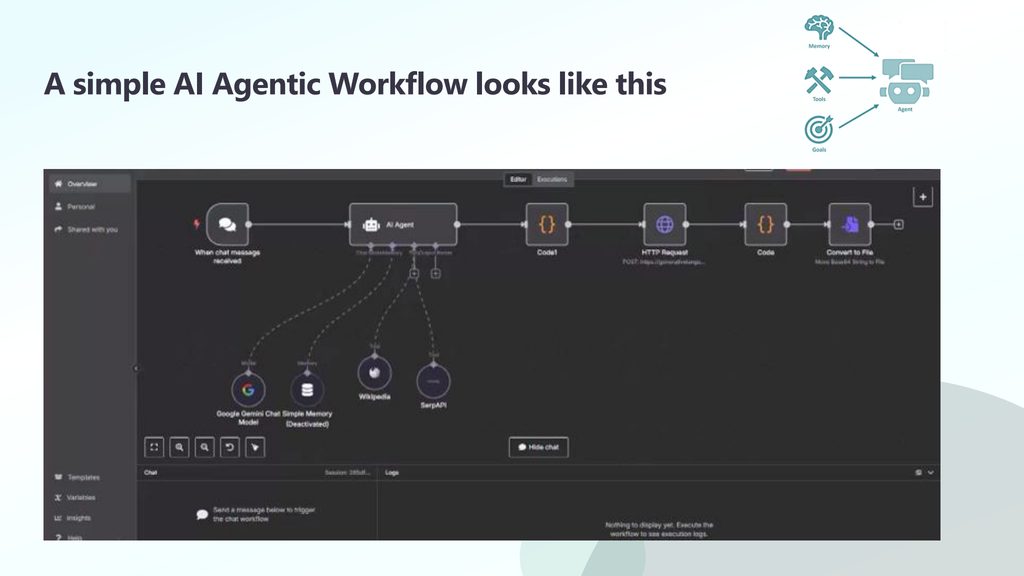
23 / 45A simple AI Agentic Workflow looks like this - A simple AI Agentic Workflow looks like this
What I say here
This is a simple one. A message comes in, an AI agent with a model, memory and a couple of tools handles it.
Boxes and arrows. Nothing magic.
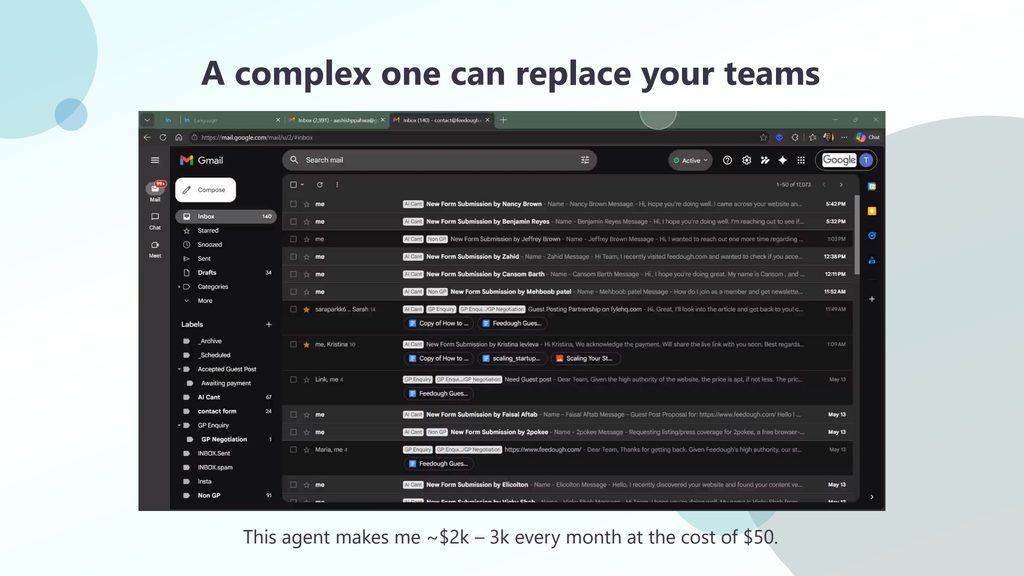
24 / 45A complex one can replace your teams - A complex one can replace your teams
- This agent makes me ~$2k – 3k every month at the cost of $50.
What I say here
This is my inbox. Every form submission here gets read, sorted and answered by an agent.
It makes me about $2k to $3k a month and costs $50 to run. That used to be somebody's job.
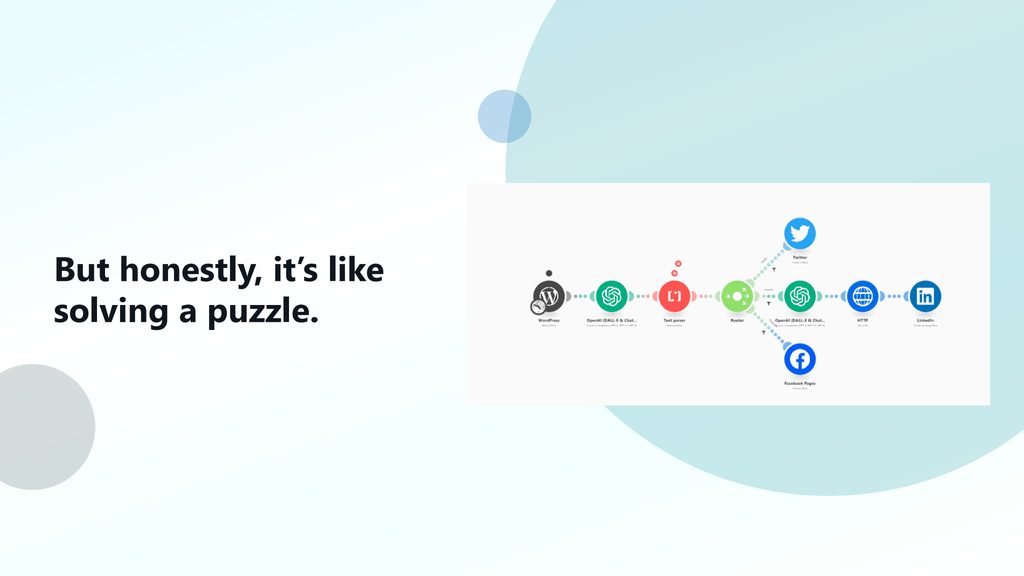
25 / 45But honestly, it's like solving a puzzle. - But honestly, it's like solving a puzzle.
What I say here
Honestly, building these is a puzzle. You take a task a person does and break it into pieces a machine can hold.
The skill is not coding. It is seeing the pieces.
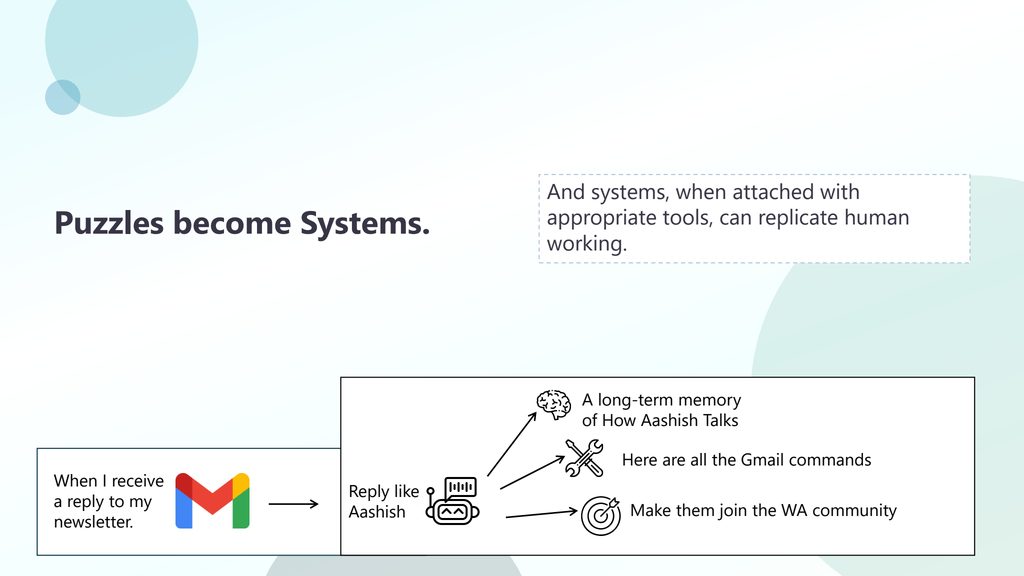
26 / 45Puzzles become Systems. - Puzzles become Systems.
- And systems, when attached with appropriate tools, can replicate human working.
- When I receive a reply to my newsletter.
- Reply like Aashish
- A long-term memory of How Aashish Talks
- Here are all the Gmail commands
- Make them join the WA community
What I say here
One puzzle, solved. Someone replies to my newsletter. The agent answers the way I would.
It has a memory of how I talk, the Gmail tools, and one goal: get them into the WhatsApp community.
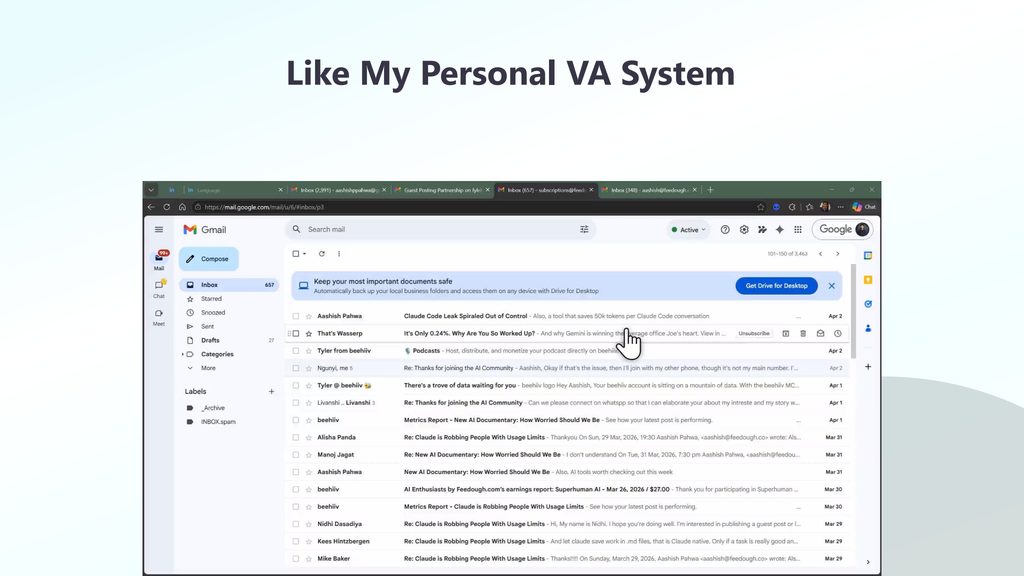
27 / 45Like My Personal VA System - Like My Personal VA System
What I say here
Put enough of those together and you get a personal assistant. This is mine, sorting my mail as it arrives.
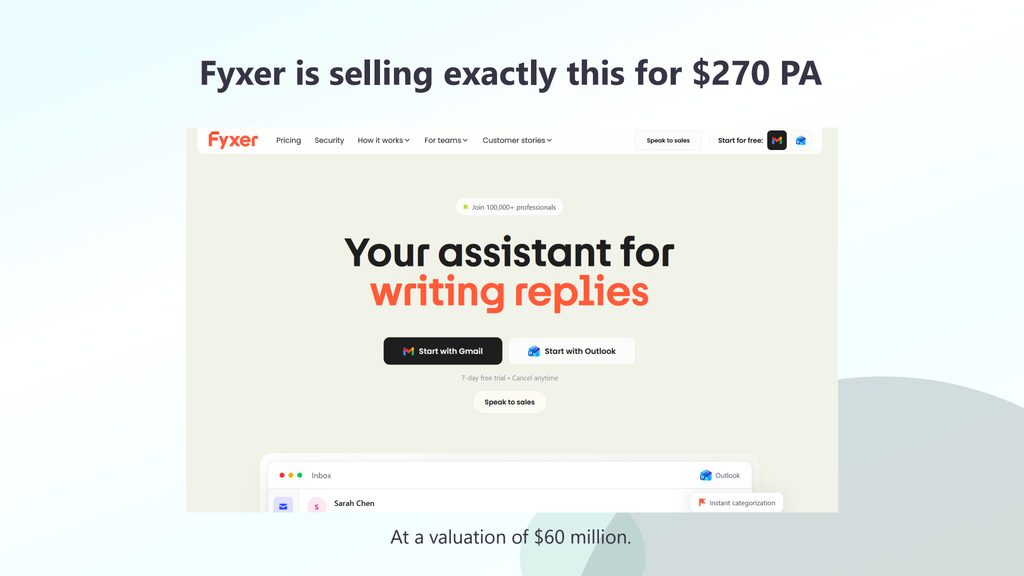
28 / 45Fyxer is selling exactly this for $270 PA - Fyxer is selling exactly this for $270 PA
- At a valuation of $60 million.
- Your assistant for writing replies
What I say here
And Fyxer sells exactly this. $270 a year, at a valuation of $60 million.
So the puzzle you solve for yourself might be someone else's company.
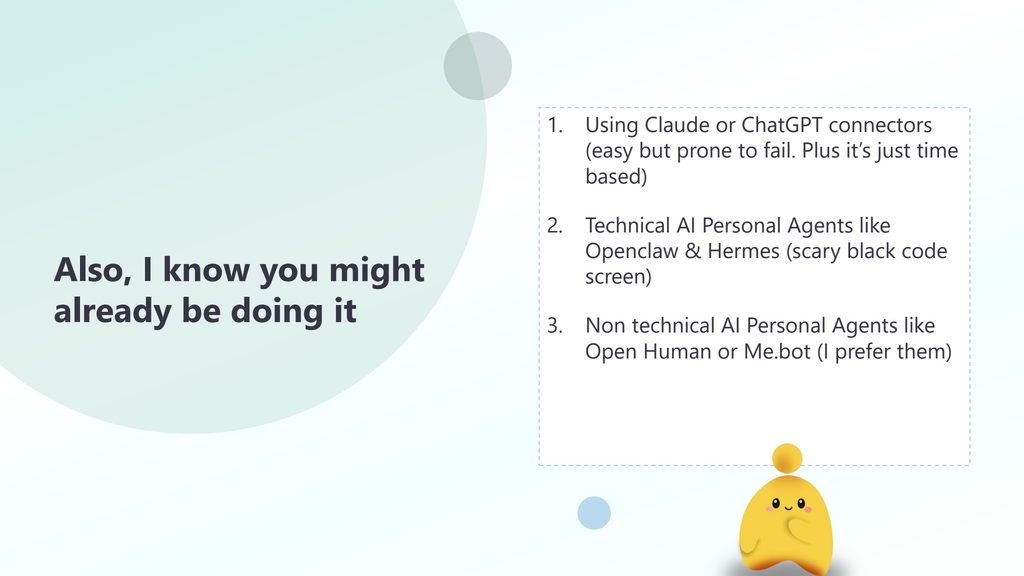
29 / 45Also, I know you might already be doing it - Using Claude or ChatGPT connectors (easy but prone to fail. Plus it's just time based)
- Technical AI Personal Agents like Openclaw & Hermes (scary black code screen)
- Non technical AI Personal Agents like Open Human or Me.bot (I prefer them)
What I say here
Some of you do a version of this already. Who uses Claude or ChatGPT connectors?
Three ways in. Connectors are easy but break. Openclaw and Hermes are powerful but it is a black code screen. I prefer the non-technical ones.
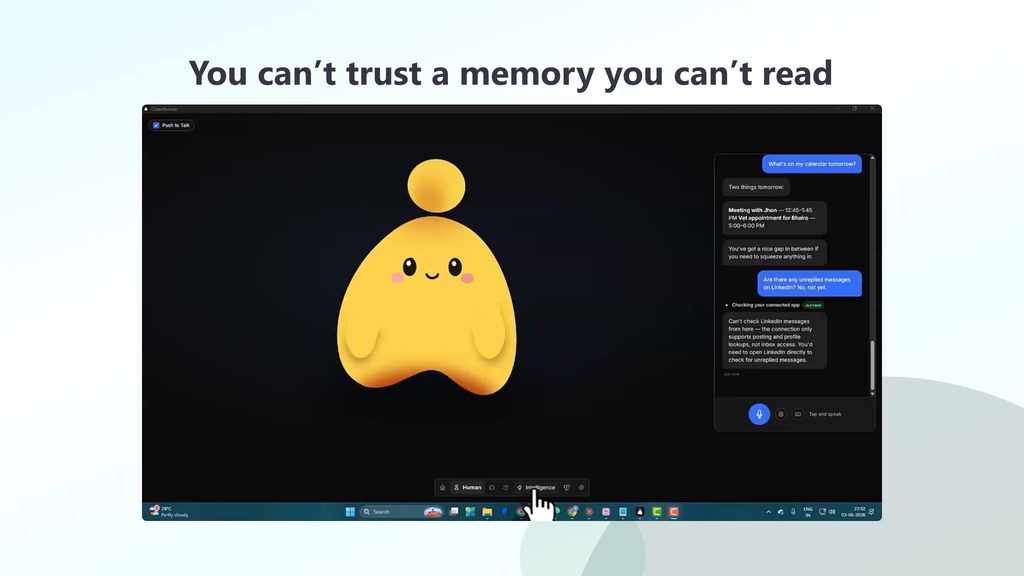
30 / 45You can't trust a memory you can't read - You can't trust a memory you can't read
What I say here
This is Open Human. It checks my calendar and tells me honestly when it cannot reach something.
The rule I use: if I cannot read what the agent remembers about me, I do not trust it.
31 / 45But they are single agents. - But they are single agents.
- And a single agent suck at multitasking.
- (Even with a long term memory)
What I say here
Here is the catch. All of these are one agent. And one agent is bad at doing many things at once.
Give it five jobs and it gets confused, even with a good memory. Same as a person, really.
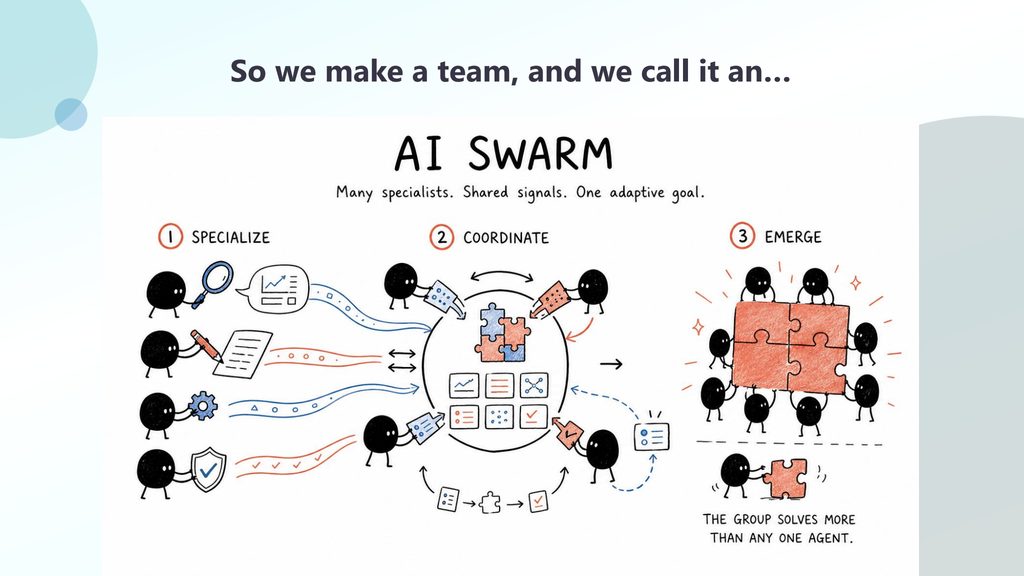
32 / 45So we make a team, and we call it an… AI Swarm - So we make a team, and we call it an…
- AI Swarm
- Many specialists. Shared signals. One adaptive goal.
- 1 Specialize
- 2 Coordinate
- 3 Emerge
- The group solves more than any one agent.
What I say here
So you do what companies do. You hire a team. That is a swarm.
Each agent specializes, they share signals, and together they solve more than any one of them could.
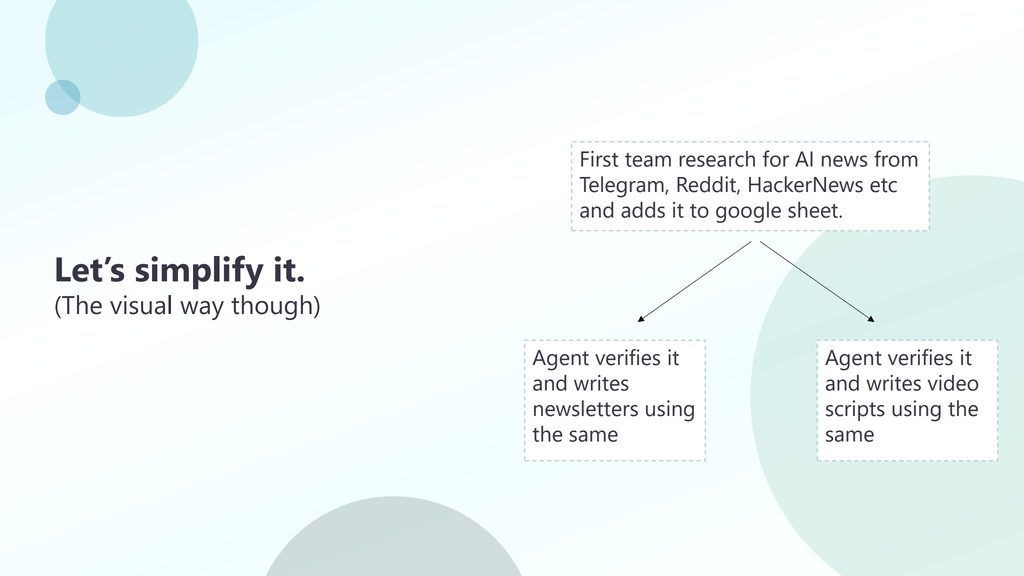
33 / 45Let's simplify it. - Let's simplify it.
- (The visual way though)
- First team research for AI news from Telegram, Reddit, HackerNews etc and adds it to google sheet.
- Agent verifies it and writes newsletters using the same
- Agent verifies it and writes video scripts using the same
What I say here
Here is one I run. One agent reads Telegram, Reddit and Hacker News for AI news and puts it in a sheet.
Two more pick it up. One checks it and writes the newsletter. The other writes video scripts.
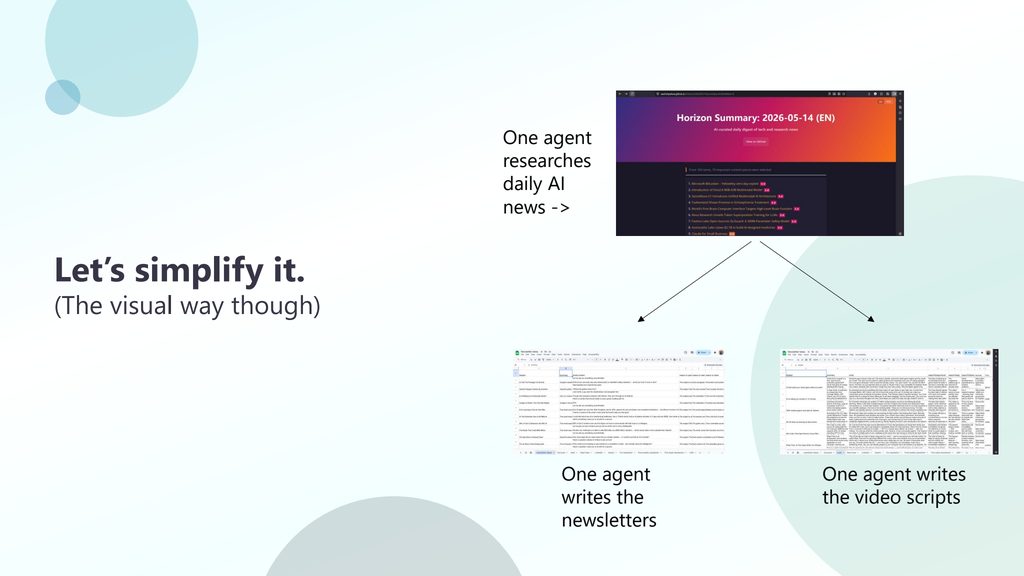
34 / 45Let's simplify it. (The visual way though) - One agent researches daily AI news ->
- One agent writes the newsletters
- One agent writes the video scripts
What I say here
Same thing with real screens. The research digest at the top, the newsletter and the scripts underneath.
That used to be a content team of three.
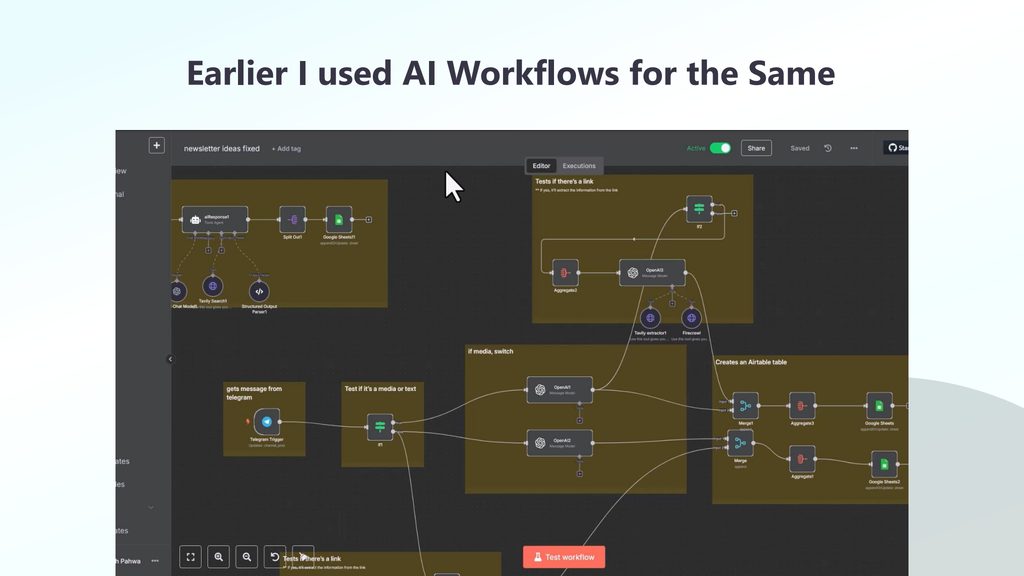
35 / 45Earlier I used AI Workflows for the Same - Earlier I used AI Workflows for the Same
What I say here
Last year I built it as a workflow. Look at it. Every box is a thing that can break.
It worked, but I was the one fixing it every week.
36 / 45But that was 2025. - But that was 2025.
- (human in the loop)
- Today, you can spawn multiple agents in Claude itself.
What I say here
That was 2025. Today Claude can spin up several agents itself, with you approving along the way.
No canvas, no wiring. You describe the team.
37 / 45But what these chatbots can't do well is Orchestrating. - But what these chatbots can't do well is
- Orchestrating.
What I say here
But there is one thing chat apps still do badly. Orchestrating.
They can start a team. They are not good at running one.
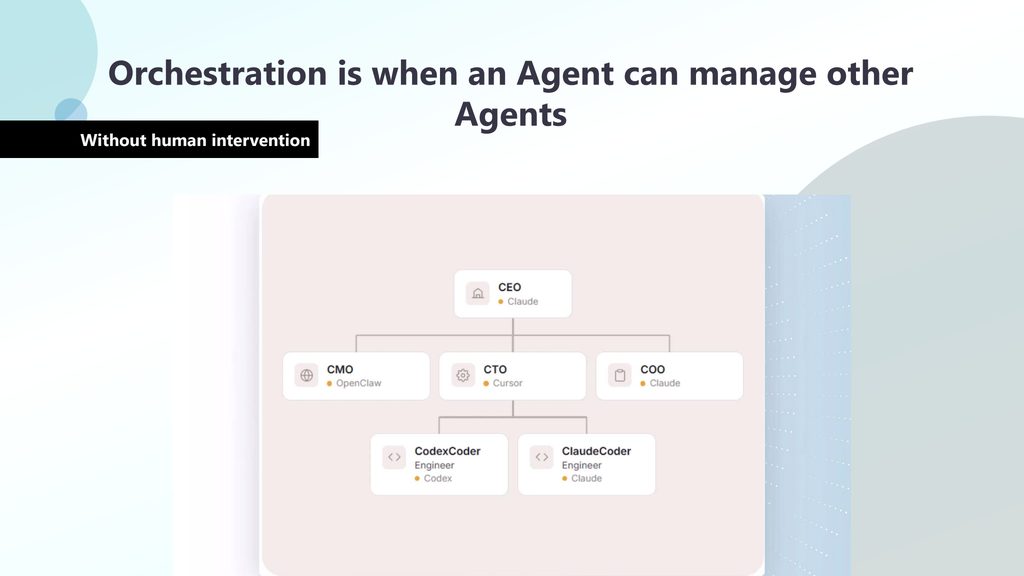
38 / 45Orchestration is when an Agent can manage other Agents - Orchestration is when an Agent can manage other Agents
- Without human intervention
- CEO: Claude
- CMO: OpenClaw
- CTO: Cursor
- COO: Claude
- CodexCoder, Engineer: Codex
- ClaudeCoder, Engineer: Claude
What I say here
Orchestration is one agent managing the others, without a human in between.
An org chart where the CEO is Claude, the CTO is Cursor, and the engineers are Codex and Claude. That is a department.
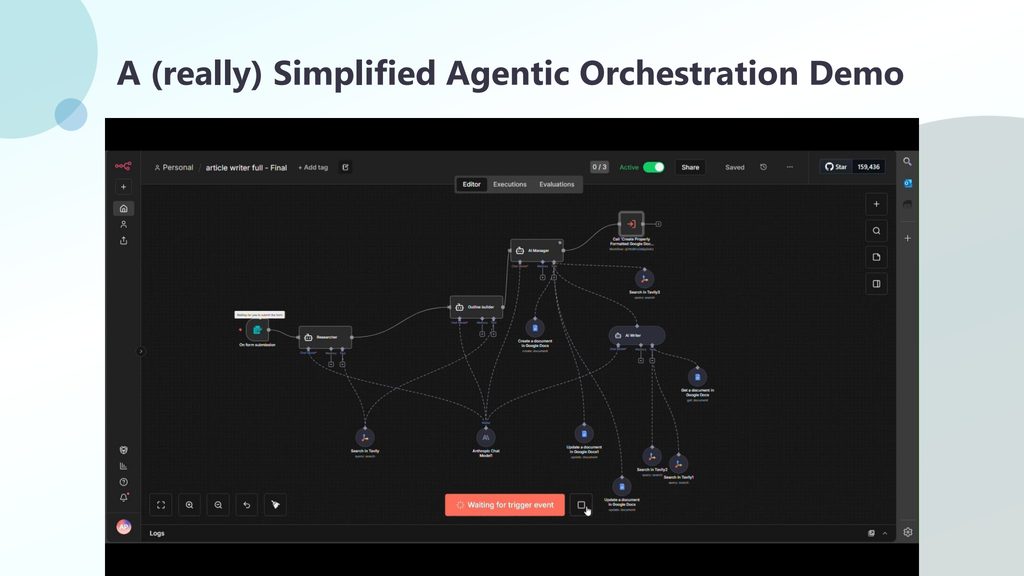
39 / 45A (really) Simplified Agentic Orchestration Demo - A (really) Simplified Agentic Orchestration Demo
What I say here
A really simplified one. An orchestrator in the middle writes articles by handing work to sub-agents and checking what comes back.
The orchestrator decides who does what next. Not me.
40 / 45Now that we're talking about agents - Now that we're talking about agents
- How are you using agents for internal productivity?
What I say here
Your turn. Hands up if you already use agents inside your company. Not for customers, for your own team.
Here are a few we have built.
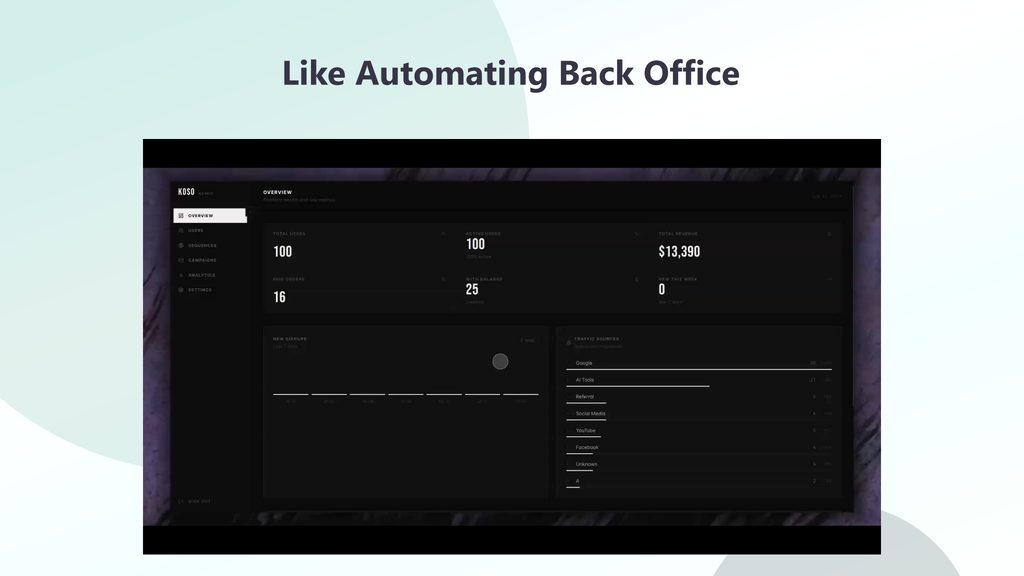
41 / 45Like Automating Back Office - Like Automating Back Office
What I say here
Back office first. It is the boring work, which makes it the best place to start.
Counts, invoices, status. Agents are good at boring.
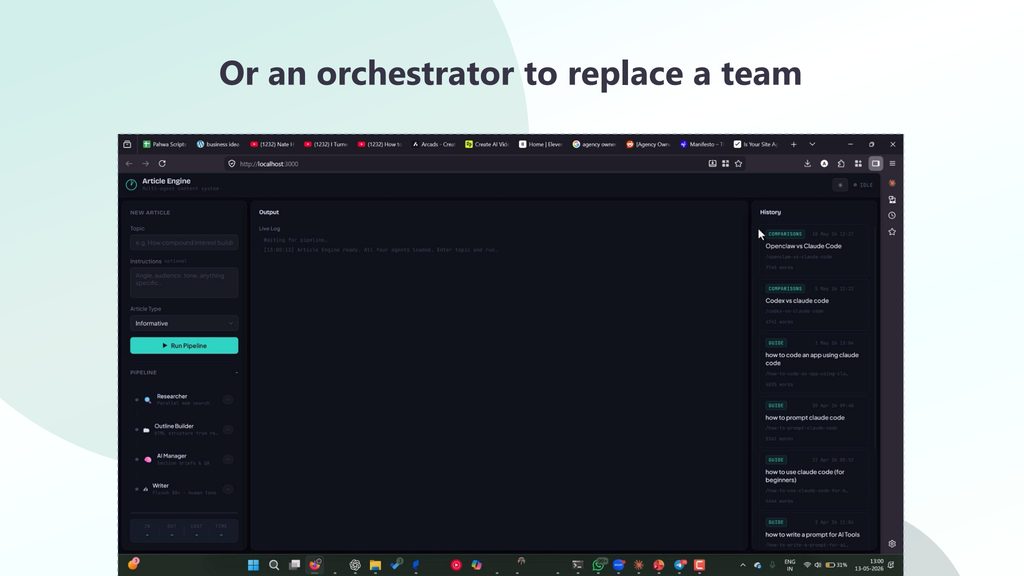
42 / 45Or an orchestrator to replace a team - Or an orchestrator to replace a team
What I say here
Or an orchestrator that runs a whole team of writing agents. You give it the brief, it gives you the finished work.
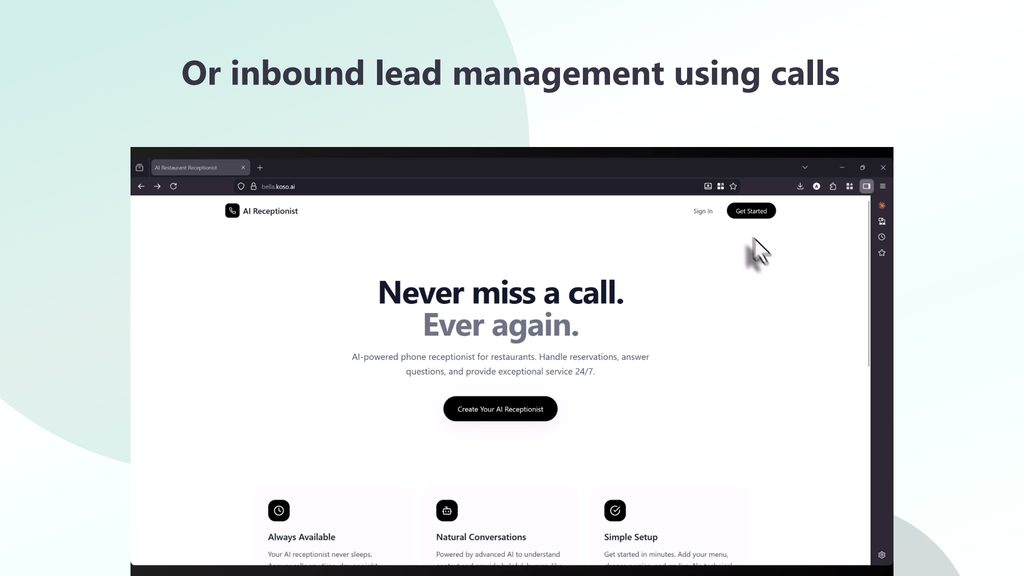
43 / 45Or inbound lead management using calls - Or inbound lead management using calls
- Never miss a call. Ever again.
What I say here
Or voice. An AI receptionist that picks up every inbound call, answers questions and books the lead.
Never miss a call again. That one is a department too.
44 / 45Let's Talk More - Let's Talk More
- (I run koso.ai)
What I say here
If you want one of these for your own company, this is where to find me. I run Koso, and this is what we build.
45 / 45You can find me here - You can find me here
- OKAashish
- Aashishpahwa
- @OKAASHISH
What I say here
And I am okaashish on most places. I post what I build, usually the week I build it.
/02
Questions
The AI here has read every slide and my notes, and it checks the web when a question needs it. Ask it what you would have asked me in the room.