/00 September 2026
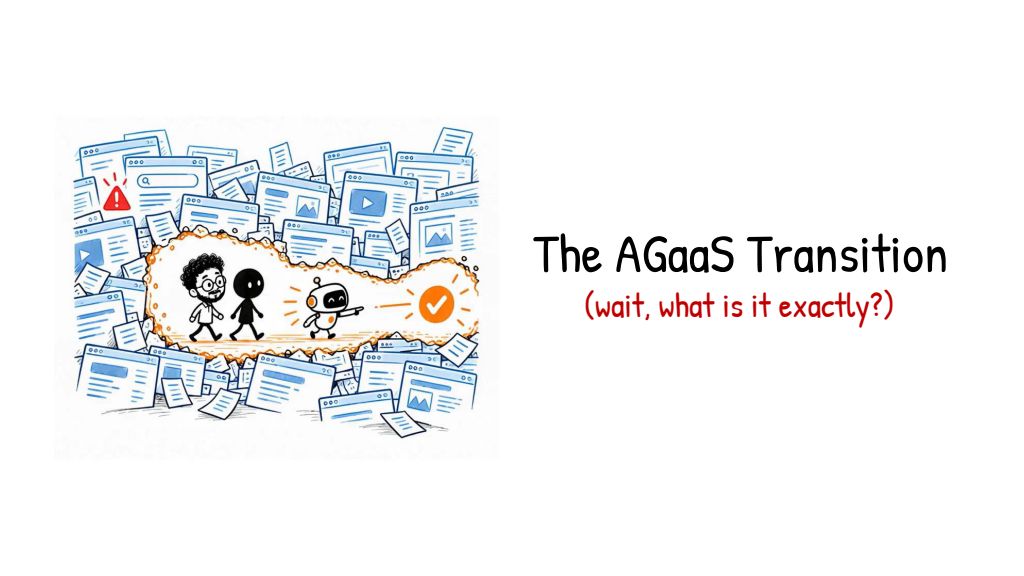
The AGaaS Transition
(wait, what is it exactly?)
SaaS was built for a person with a mouse. The next user of your product is an agent with a goal. What Agentic-as-a-Service means, the three layers of getting there, and how to market to a reader with no eyes.
It plays in my pixel town: the slides on a real screen, me talking over each one. About six minutes.
/01
The deck
Every slide, and what I say over it. The bubbles are the talk. The slides are the excuse.
1 / 33The AGaaS Transition - (wait, what is it exactly?)
What I say here
Agentic as a Service. Half of you saw the term this month and nodded. Nobody is sure what it means yet, so let us work it out together.
I run a company that builds this stuff, so I have skin in it. Argue with me.
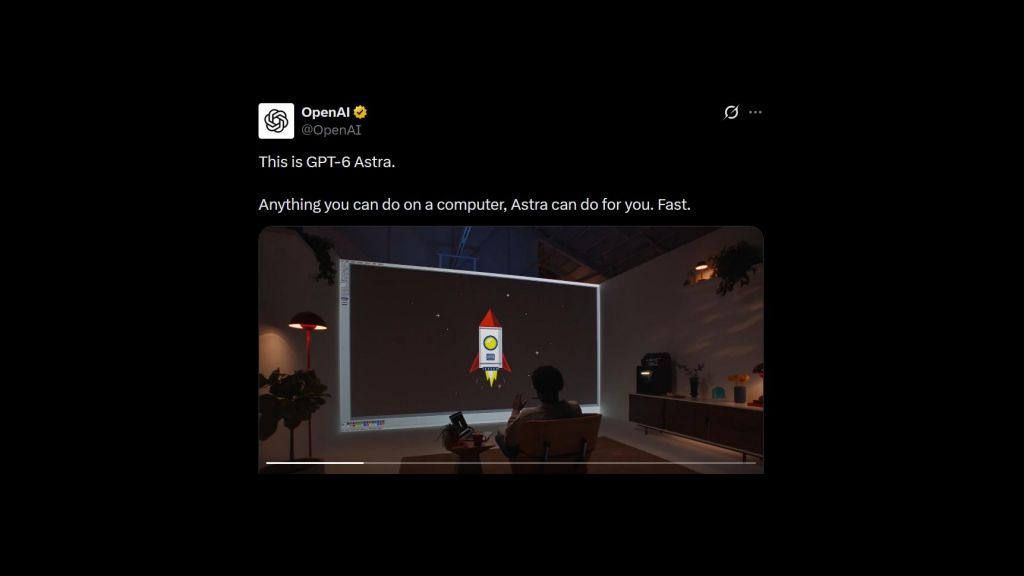
2 / 33Anything you can do on a computer - OpenAI: This is GPT-6 Astra.
- Anything you can do on a computer, Astra can do for you. Fast.
What I say here
OpenAI put this out. One line. Anything you can do on a computer, it can do for you.
Read it as someone who builds a product, not as a user. Your product is a thing people do on a computer.
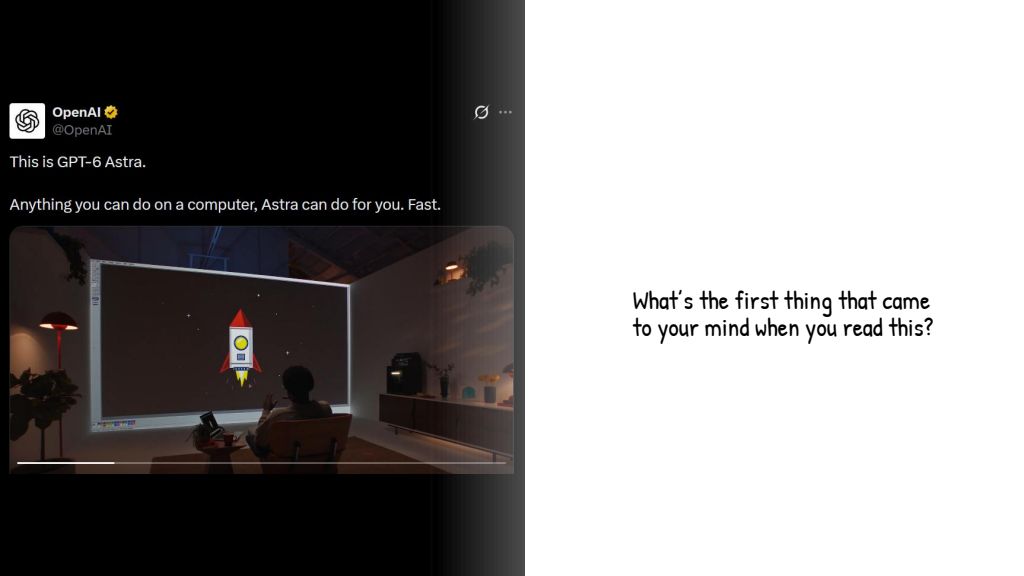
3 / 33What's the first thing that came to your mind? - What's the first thing that came to your mind when you read this?
What I say here
Hands up. What did you think of first?
Most people say jobs. I thought of something else, and it is on the next slide.
4 / 33My users are changing - The only thing I can think of:
- My users are changing.
What I say here
Mine is this. My users are changing.
Not shrinking, not leaving. Changing into something that does not have a mouse.
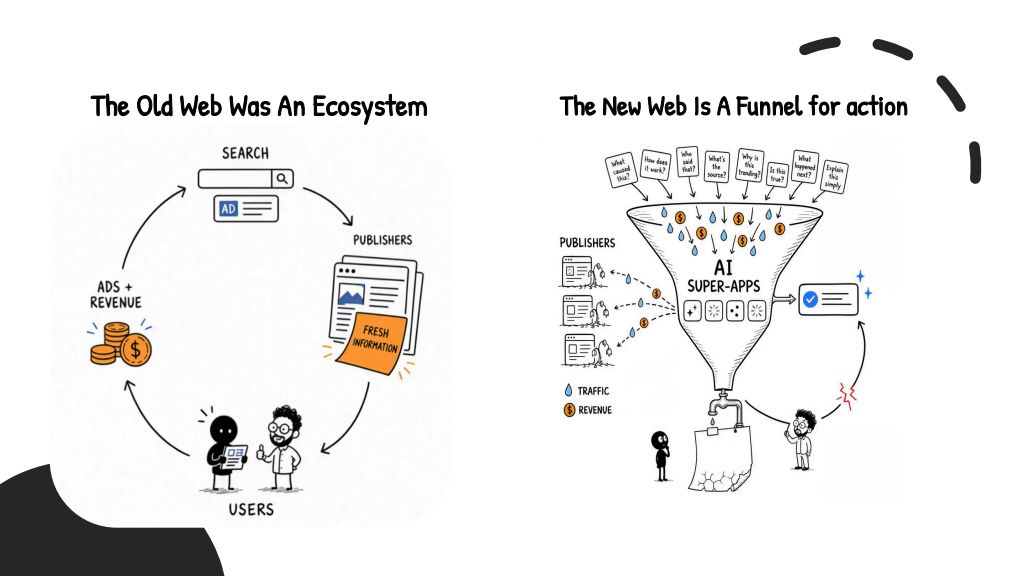
5 / 33The old web was an ecosystem. The new web is a funnel for action. - Old web: search sent users to publishers, publishers earned from ads, users came back round
- New web: publishers feed a few AI super-apps, the user gets the action, and the traffic and revenue do not come back down
What I say here
The old web was a loop. Search sent people to publishers, publishers sold ads, everyone ate.
The new web is a funnel. Publishers pour into a few AI apps, the answer comes out the bottom, and the traffic does not come back up.
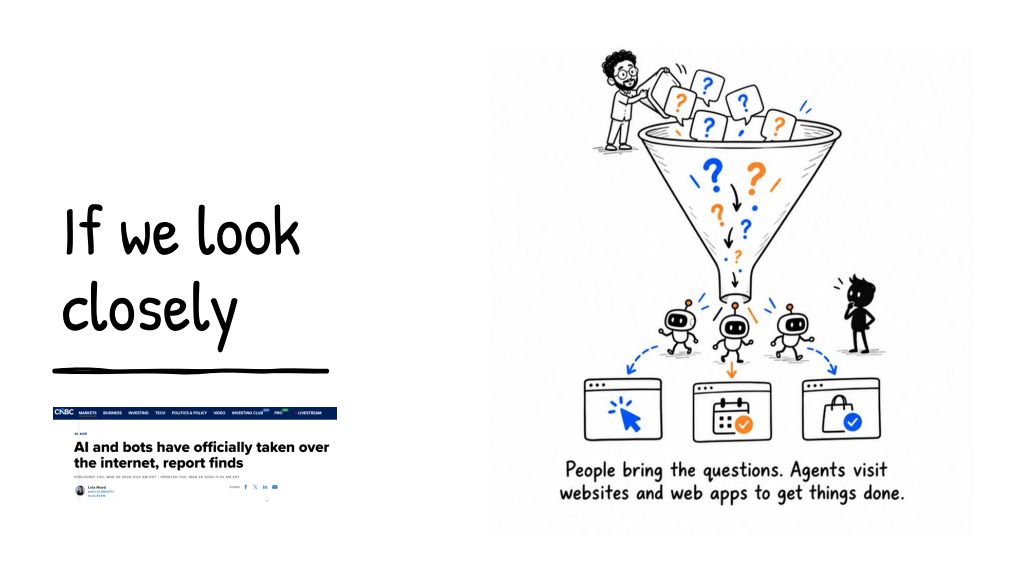
6 / 33If we look closely - AI and bots have officially taken over the internet, report finds
- People bring the questions. Agents visit websites and web apps to get things done.
What I say here
This is not a forecast. The report is out. Bots are now most of the traffic on the internet.
Some of that is scrapers. More of it every month is an agent running an errand for a person.
So the visitor on your analytics is, increasingly, a piece of software with a goal.
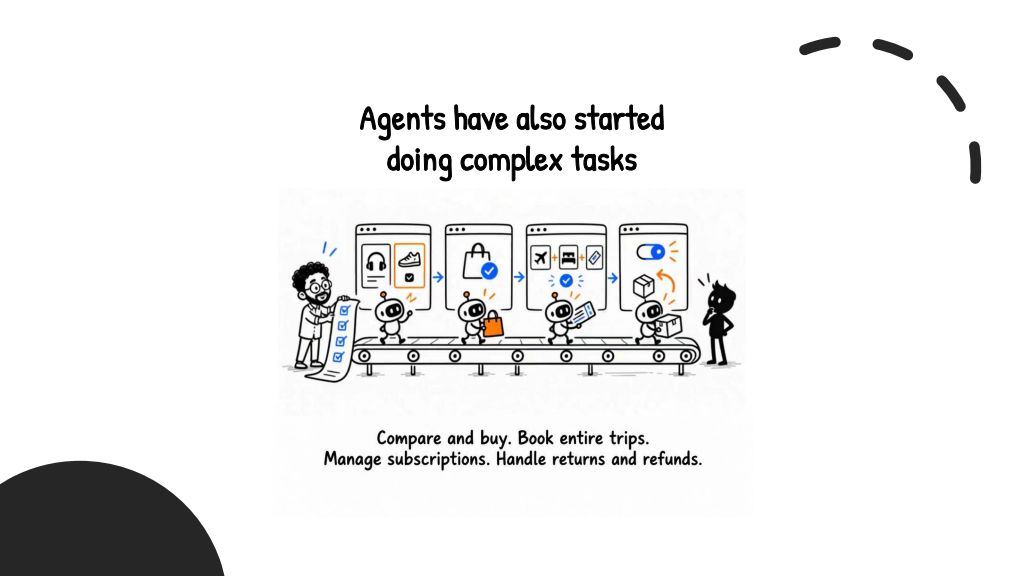
7 / 33Agents have also started doing complex tasks - Compare and buy
- Book entire trips
- Manage subscriptions
- Handle returns and refunds
What I say here
Not just answering questions any more. Comparing and buying. Booking the whole trip. Cancelling the subscription you forgot about.
The boring multi-step stuff. Which is most of what SaaS is.
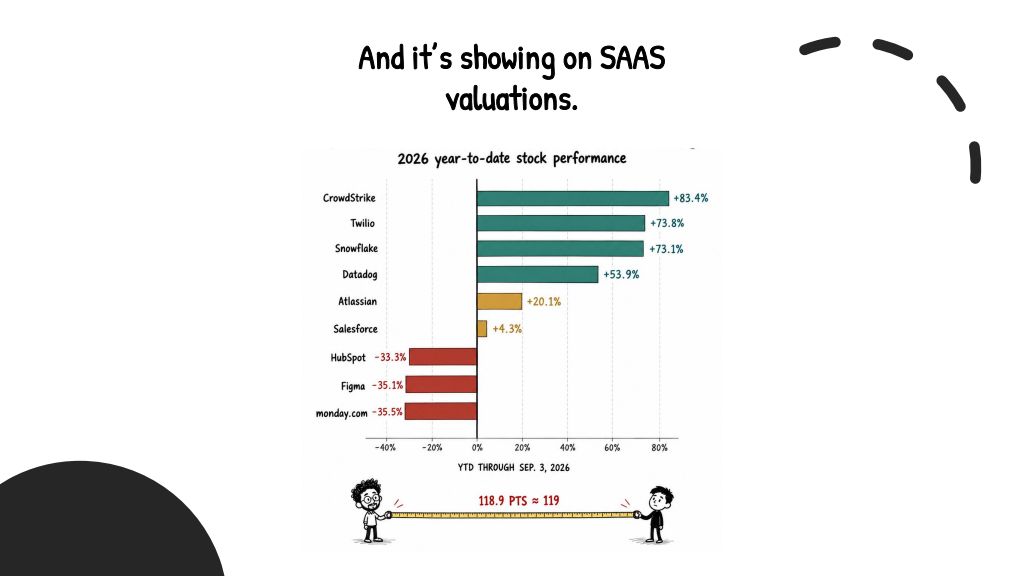
8 / 33And it's showing on SaaS valuations - 2026 year-to-date stock performance
- Up: CrowdStrike, Twilio, Snowflake, Datadog, Atlassian, Salesforce
- Down: HubSpot, Figma, monday.com
What I say here
Look at the bottom of this chart. The names going down sell seats and a screen.
The names going up sell the plumbing agents run on. The market is pricing the thesis before most companies have heard it.
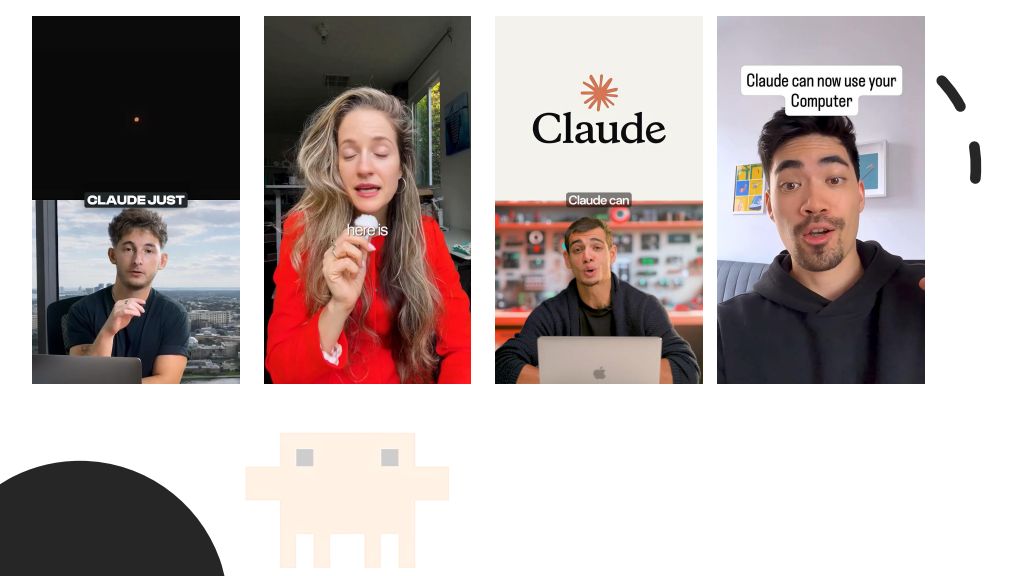
9 / 33The reels write themselves - Claude just...
- Claude can now use your computer
- A new clip every week of an agent clicking through someone's screen
What I say here
If you follow my page you have seen these. Every week, a new clip of Claude clicking through somebody's screen.
I make these videos. The reaction is always the same. A laugh, and then a very quiet 'wait'.
10 / 33Time to ask - Is my product built just for humans, or for AI agents too?
What I say here
So here is the question for every product. Is it built for humans only, or for agents too?
It is not a philosophical question. It is a roadmap question.
11 / 33What is AGaaS? - Agentic-as-a-Service is a cloud service that provides AI agents capable of completing work on a user's behalf.
What I say here
The definition. A cloud service that provides agents that complete work on the user's behalf.
Notice the verb. Complete. Not assist, not suggest. Complete.
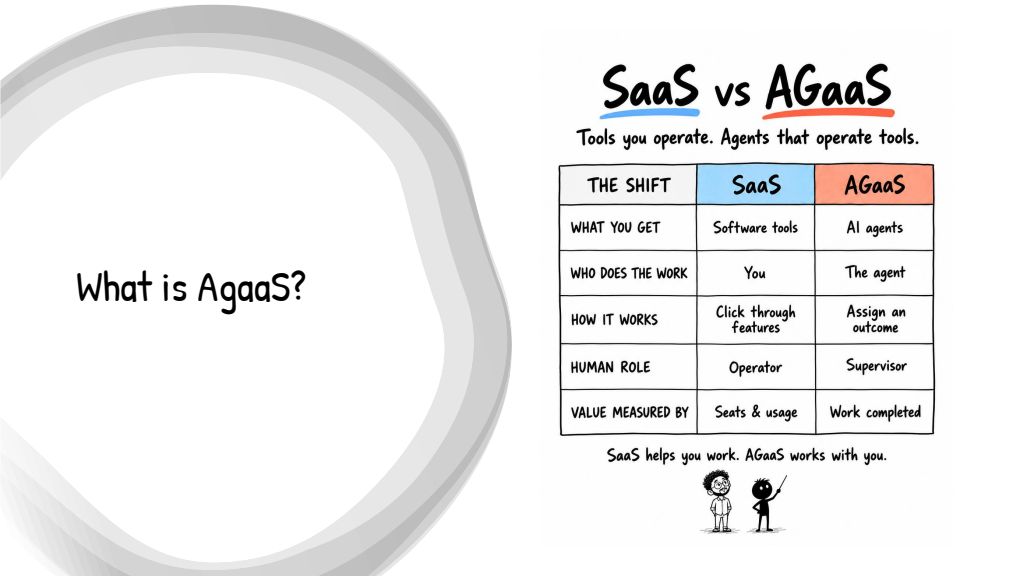
12 / 33SaaS vs AGaaS - Tools you operate. Agents that operate tools.
- What you get: software tools, or AI agents
- Who does the work: you, or the agent
- How it works: click through features, or assign an outcome
- Human role: operator, or supervisor
- Value measured by: seats and usage, or work completed
- SaaS helps you work. AGaaS works with you.
What I say here
Tools you operate versus agents that operate tools. That is the whole table in one line.
The row that matters is the last one. Seats and usage, versus work completed. Your pricing lives in that row.
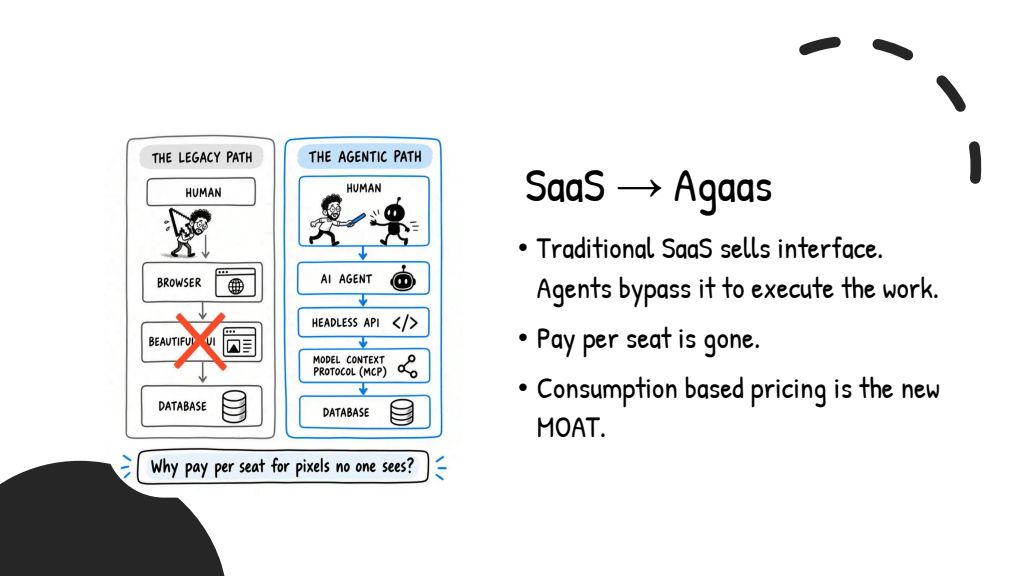
13 / 33SaaS to AGaaS - Traditional SaaS sells interface. Agents bypass it to execute the work.
- Pay per seat is gone.
- Consumption based pricing is the new moat.
- Why pay per seat for pixels no one sees?
What I say here
SaaS sells an interface. The agent does not want your interface. It wants the API underneath it.
Why pay per seat for pixels nobody sees? Your customers will say that sentence to you before you say it to them.
Consumption pricing is the moat now. Charge for work done, not for chairs.
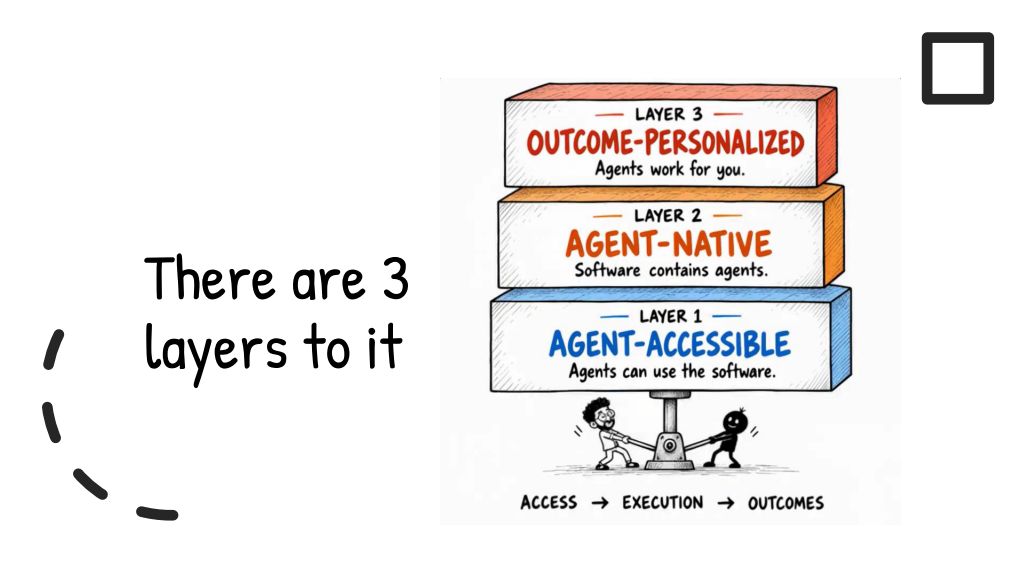
14 / 33There are 3 layers to it - Layer 1, agent-accessible: agents can use the software
- Layer 2, agent-native: the software contains agents
- Layer 3, outcome-personalized: the agents work for you
- Access, then execution, then outcomes
What I say here
Three layers. Agents can use your software. Your software contains agents. The agents work for the person.
Most of you are at zero today. That is fine. It is a ladder, not a verdict.
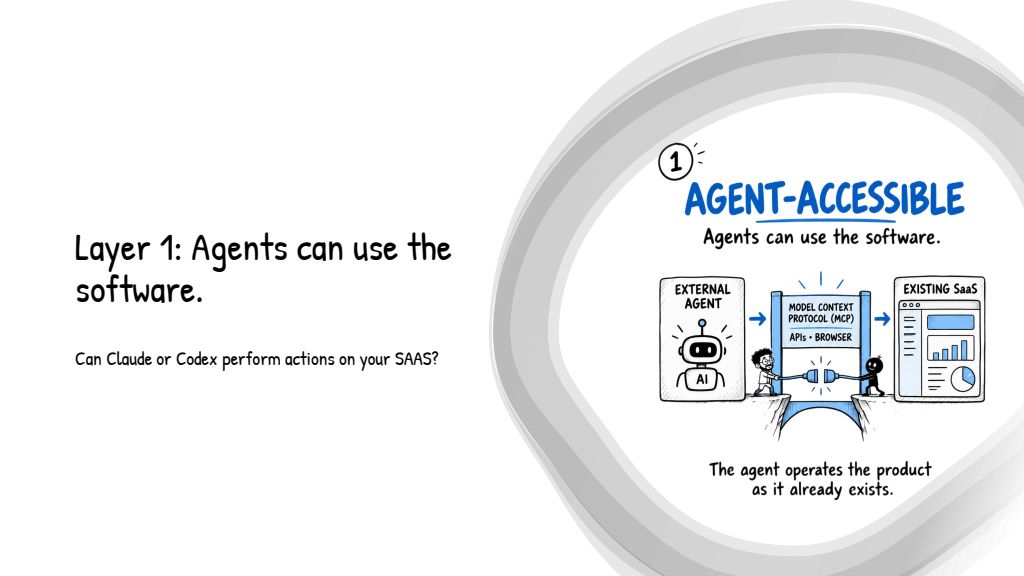
15 / 33Layer 1: Agents can use the software - Can Claude or Codex perform actions on your SaaS?
- An external agent reaches the existing product through MCP, an API, or a browser
- The agent operates the product as it already exists
What I say here
Layer one. Can Claude or Codex actually do something inside your product today? Not read about it. Do it.
Try it tonight. Open Claude, point it at your app, ask it to finish one real task. Watch where it gets stuck. That is your backlog.
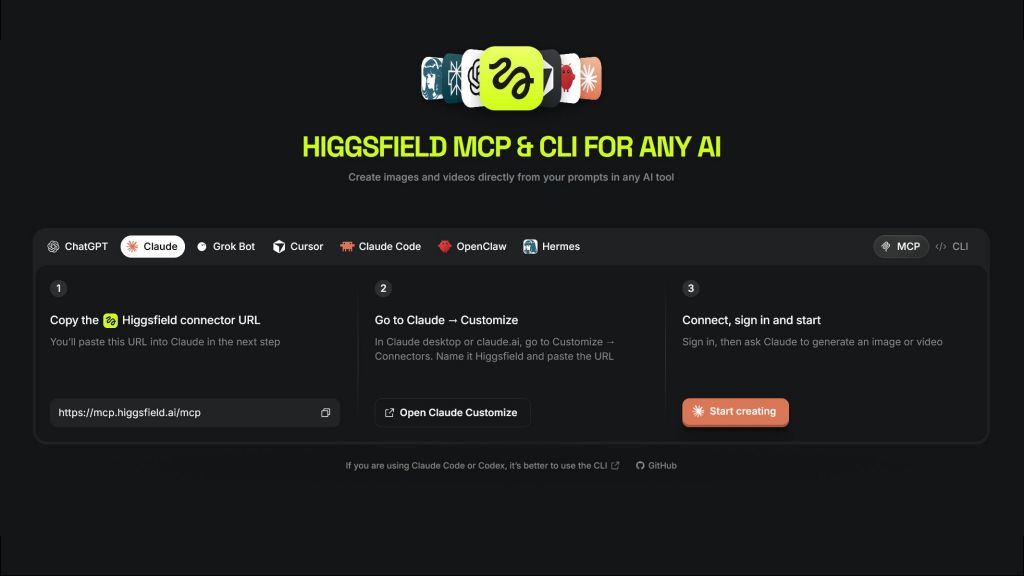
16 / 33Example: Higgsfield MCP and CLI - Higgsfield MCP and CLI for any AI
- Copy the connector URL, add it to ChatGPT, Claude, Cursor or Claude Code, and start creating
What I say here
Higgsfield, a video tool. They shipped an MCP and a CLI so any AI can drive them. Three steps and one URL.
That is layer one done in a weekend. No new product. Just a door.
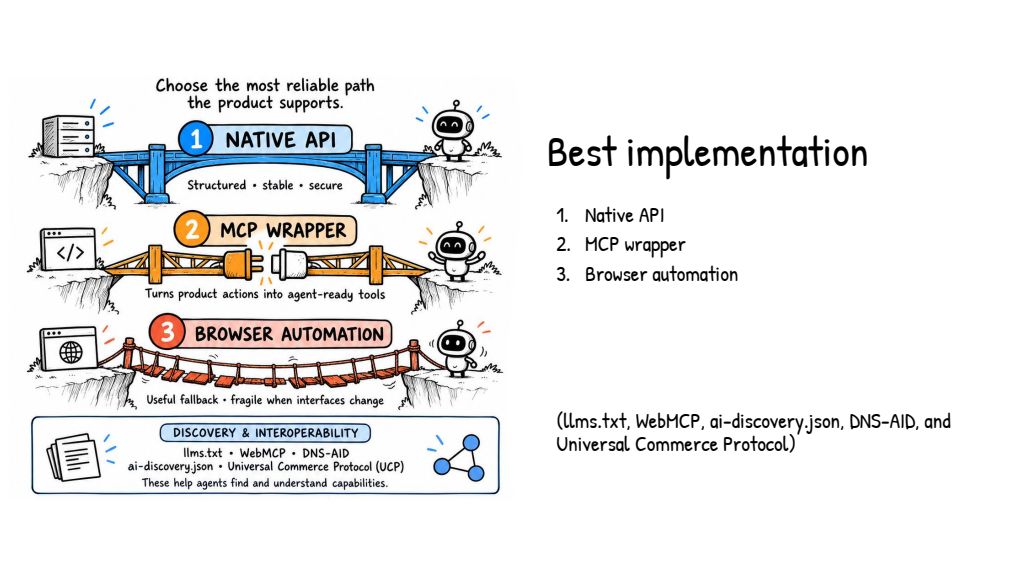
17 / 33Best implementation - 1. Native API: structured, stable, secure
- 2. MCP wrapper: turns product actions into agent-ready tools
- 3. Browser automation: a useful fallback, fragile when interfaces change
- Discovery and interoperability: llms.txt, WebMCP, ai-discovery.json, DNS-AID, and the Universal Commerce Protocol
What I say here
In order of how much I trust them. A native API. An MCP wrapper over it. Browser automation last, because it breaks every time you move a button.
Then the discovery layer, so agents can find the door. llms.txt, WebMCP, ai-discovery.json, DNS-AID, and the Universal Commerce Protocol.
Ask me about any of them after.
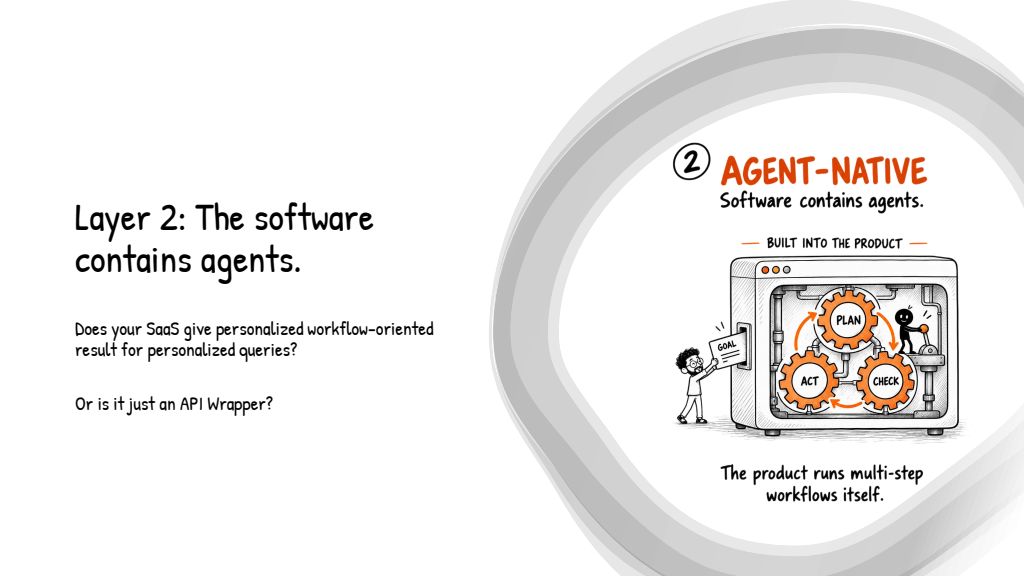
18 / 33Layer 2: The software contains agents - Does your SaaS give a personalized, workflow-oriented result for personalized queries?
- Or is it just an API wrapper?
- Built into the product: plan, act, check. The product runs multi-step workflows itself.
What I say here
Layer two. Your product has agents inside it. It plans, acts, checks, and hands back a finished result.
The test: does a personal question get a personal, finished answer? Or is it a chat box glued onto your API?
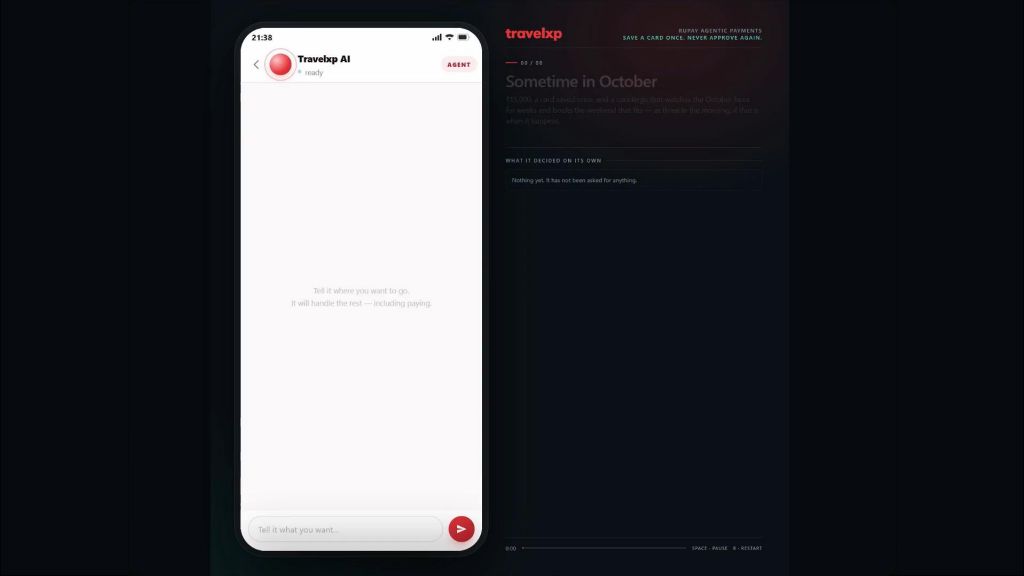
19 / 33Example: a travel agent that pays - Travelxp AI: tell it where you want to go, it handles the rest, including paying
- Agentic payments: save a card once, never approve again
What I say here
A travel product doing layer two properly. You tell it where you want to go. It handles the rest, including paying.
Save a card once, never approve again. Notice how much product disappears when the interface is a sentence.
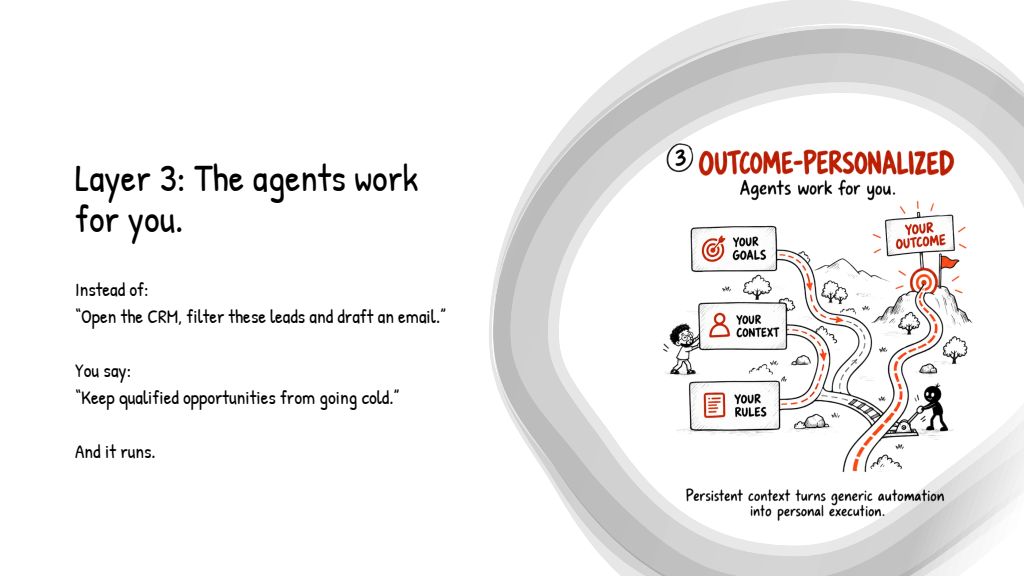
20 / 33Layer 3: The agents work for you - Instead of: open the CRM, filter these leads and draft an email.
- You say: keep qualified opportunities from going cold.
- And it runs.
- Your goals, your context, your rules. Persistent context turns generic automation into personal execution.
What I say here
Layer three. You stop giving instructions and start giving outcomes.
Not 'open the CRM, filter, draft'. Just 'keep qualified deals from going cold'. And it runs, with your context and your rules, every day.
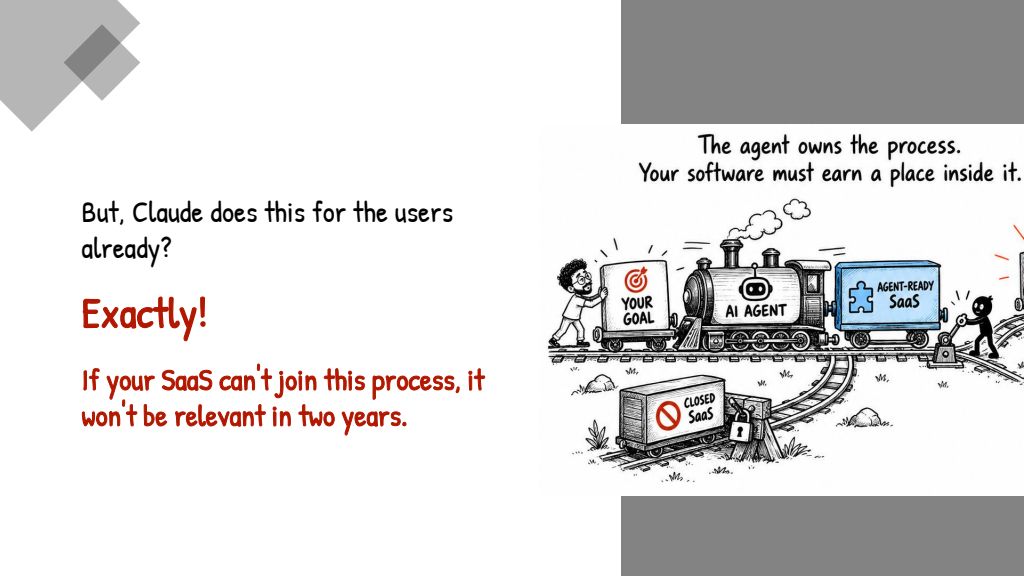
21 / 33But Claude does this for the users already? - Exactly.
- If your SaaS can't join this process, it won't be relevant in two years.
- The agent owns the process. Your software must earn a place inside it.
What I say here
Somebody always says it. Claude already does this for me. Yes. Exactly.
The agent owns the process now. Your software has to earn a seat on the train. The closed one is the wagon in the ditch.
If your product cannot join that process, the agent routes around you. Two years is my guess, and I am usually late.
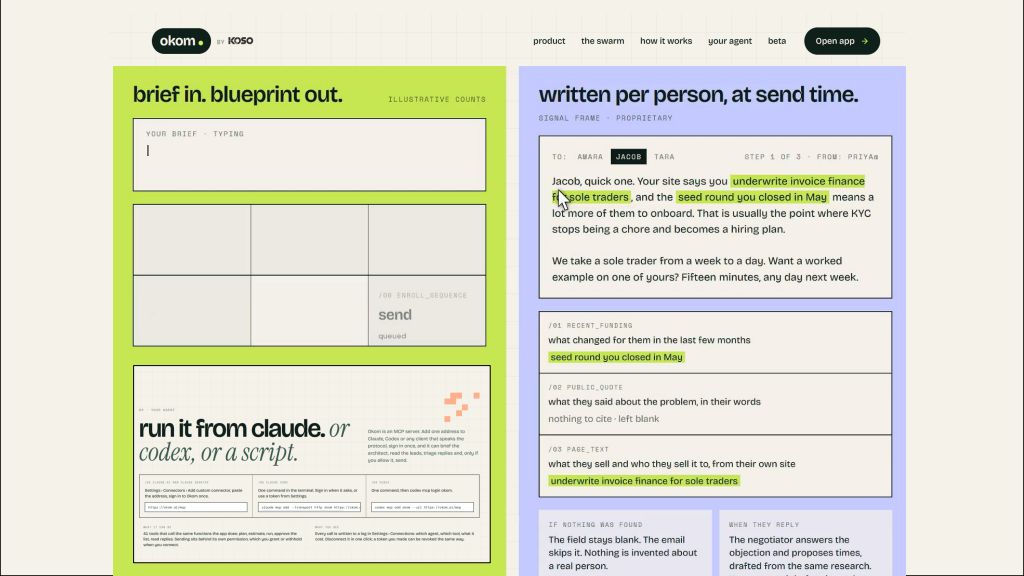
22 / 33Example: Okom - Brief in, blueprint out
- Every email written per person, at send time, from that lead's research
- Run it from Claude, or Codex, or a script
What I say here
This one is ours. Okom. You write one sentence about who you want to reach and why, and it draws the campaign as a flowchart you can edit.
Every email is written at send time from that lead's research. And because it is an MCP server, you can run the whole thing from Claude or Codex.
23 / 33AI isn't replacing humans. It's just replacing effort. What I say here
Let me say the calm version. AI is not replacing humans. It is replacing effort.
The effort of clicking through your product was never the value. It was the tax.
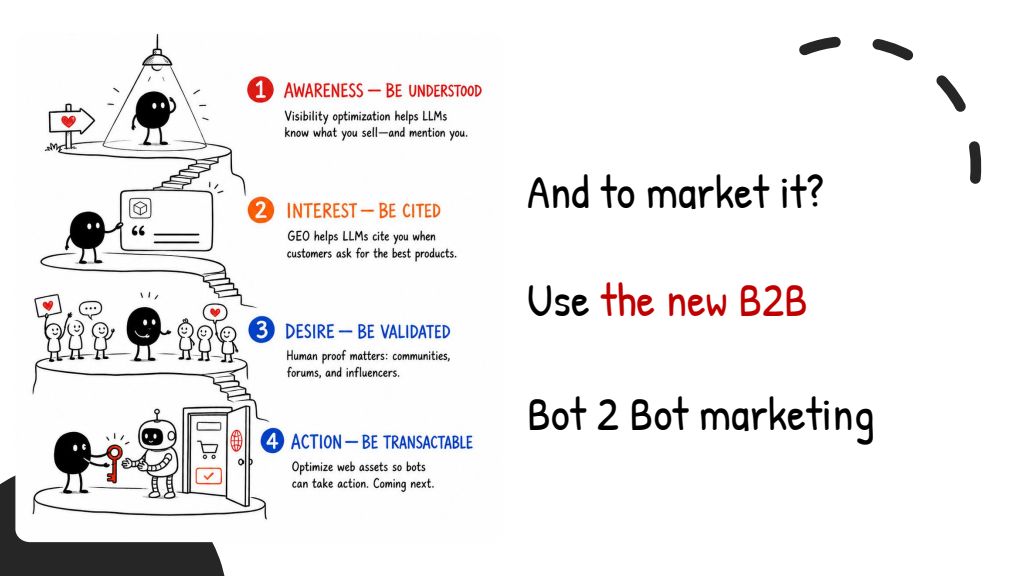
24 / 33And to market it? The new B2B: Bot 2 Bot marketing - 1. Awareness, be understood: visibility optimization helps LLMs know what you sell and mention you
- 2. Interest, be cited: GEO helps LLMs cite you when customers ask for the best products
- 3. Desire, be validated: human proof matters, communities, forums and influencers
- 4. Action, be transactable: optimize web assets so bots can take action
What I say here
Now the marketing half. The new B2B is bot to bot. Their agent talks to your agent.
Same old funnel, new reader. Awareness, interest, desire, action. Be understood, be cited, be validated, be transactable.
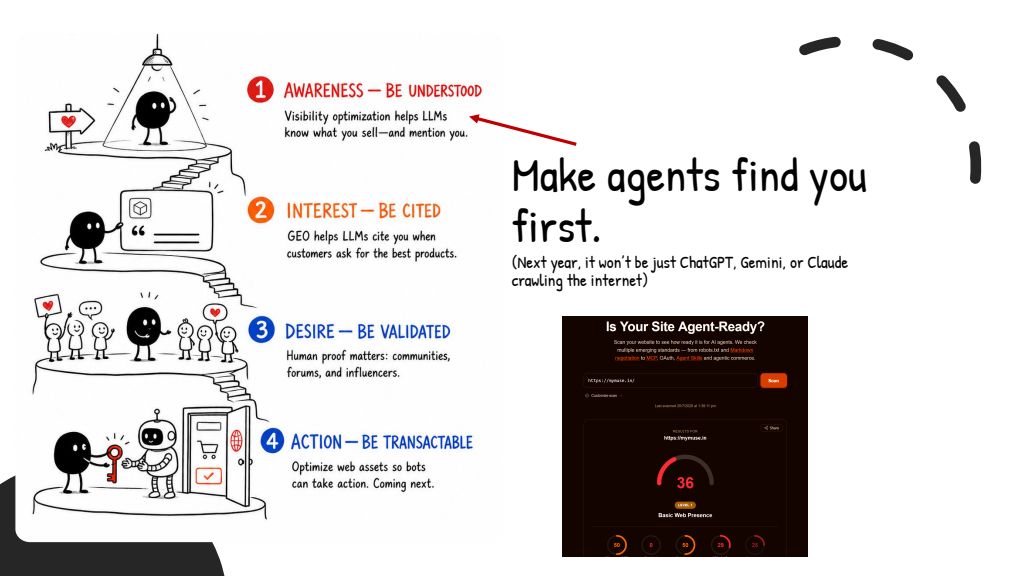
25 / 33Make agents find you first - Next year, it won't be just ChatGPT, Gemini, or Claude crawling the internet
- Is your site agent-ready? Most sites score like this one: 36, basic web presence
What I say here
Step one. Make agents find you first. Next year it is not three crawlers, it is every agent anyone runs.
We built a checker for this. Most sites score like this one. Thirty six.
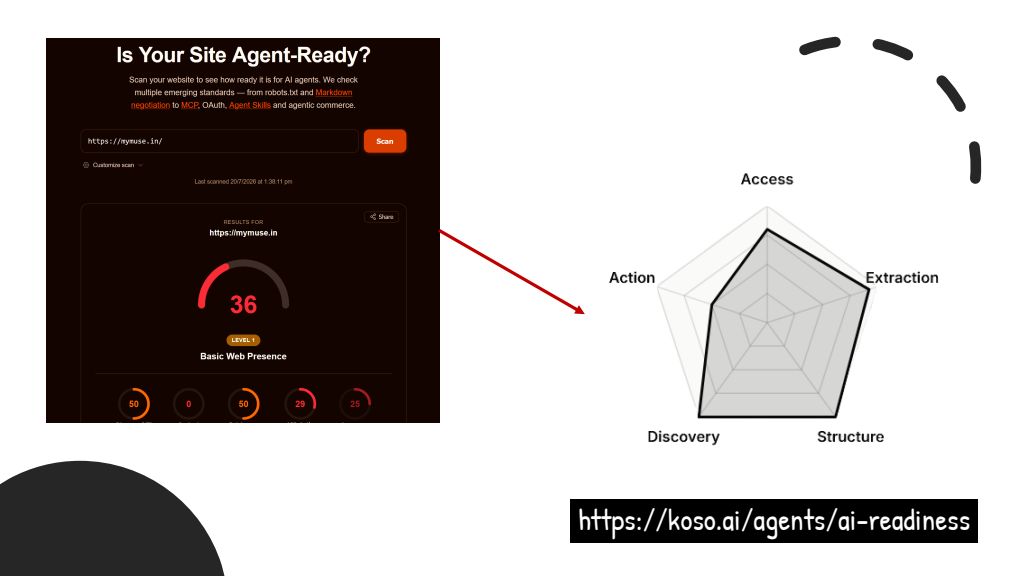
26 / 33Is your site agent-ready? - koso.ai/agents/ai-readiness
- Five things it scores: access, extraction, structure, discovery, action
What I say here
Five things it checks. Can an agent get in, read you, understand your structure, find you, and act.
Run your own site through it tonight. It is free, and it is a little rude.
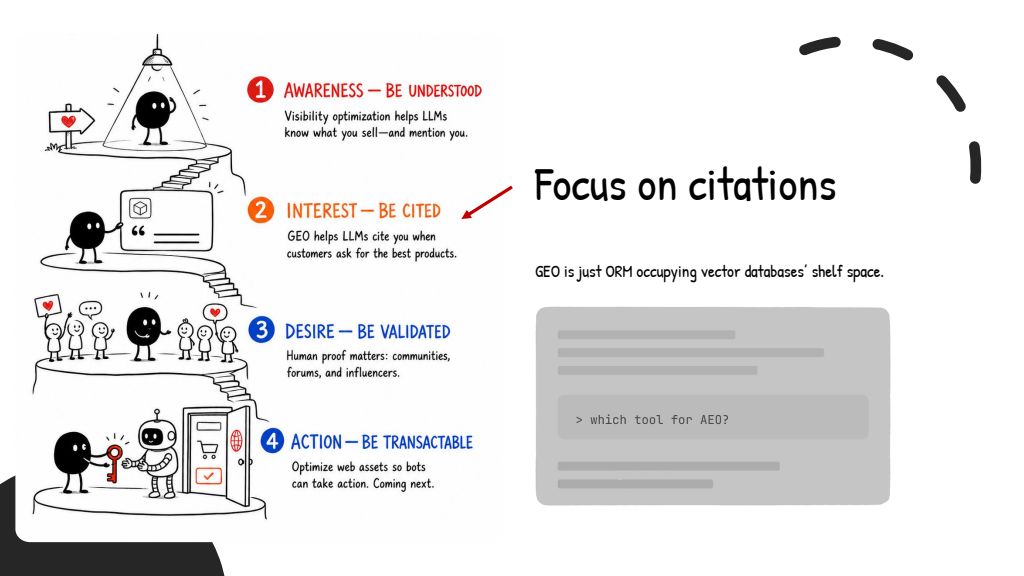
27 / 33Focus on citations - GEO is just ORM occupying vector databases' shelf space.
- Which tool for AEO? Be the answer to that prompt.
What I say here
Interest means being cited. GEO, AEO, whatever the acronym is this month, is reputation management for vector databases.
You want to be the sentence the model reaches for when somebody asks the question.
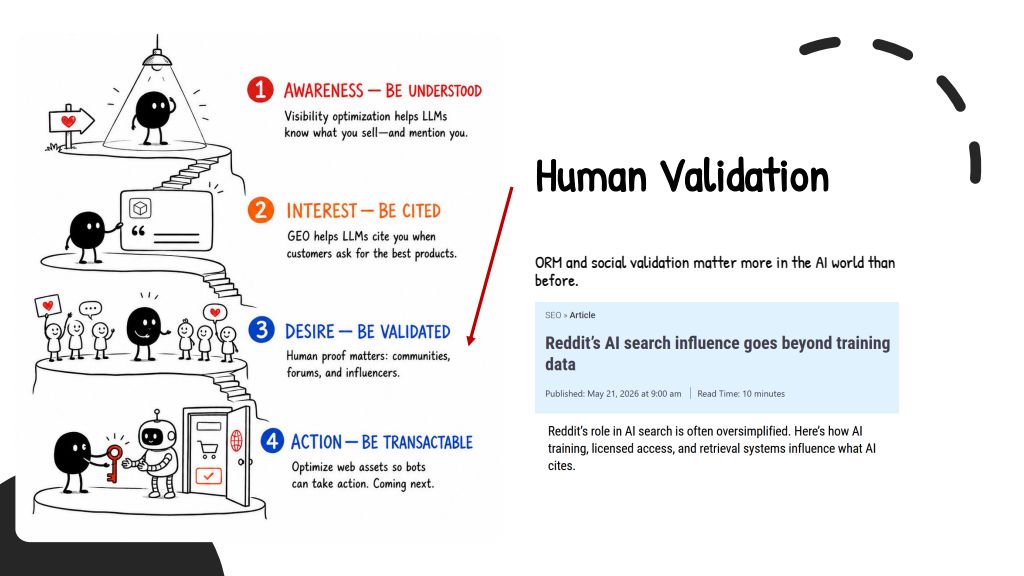
28 / 33Human validation - ORM and social validation matter more in the AI world than before.
- Reddit's AI search influence goes beyond training data: licensed access and retrieval systems shape what AI cites.
What I say here
Desire is validation, and it is still humans doing it. Reviews, forums, creators, Reddit threads.
The model treats a real person saying you are good as evidence. Your ad, it treats as an ad.
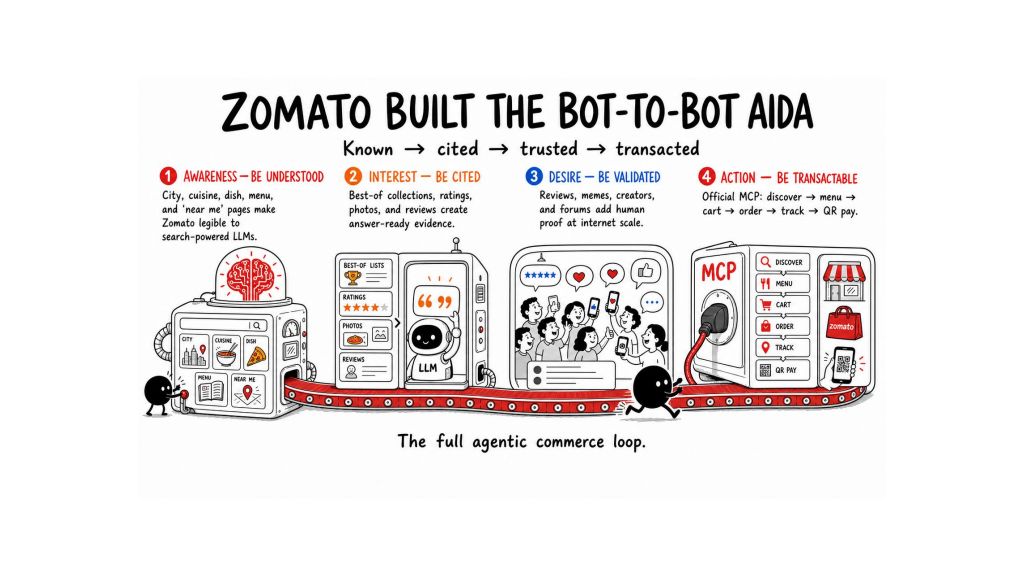
29 / 33Zomato built the bot-to-bot AIDA - Known, cited, trusted, transacted
- Awareness: city, cuisine, dish, menu and near-me pages make Zomato legible to search-powered LLMs
- Interest: best-of collections, ratings, photos and reviews create answer-ready evidence
- Desire: reviews, memes, creators and forums add human proof at internet scale
- Action: an official MCP: discover, menu, cart, order, track, QR pay
- The full agentic commerce loop
What I say here
Zomato has the whole loop. Pages an LLM can read, best-of lists it can cite, a crowd that validates, and an MCP to order with.
Known, cited, trusted, transacted. That is the funnel drawn for a reader with no eyes.
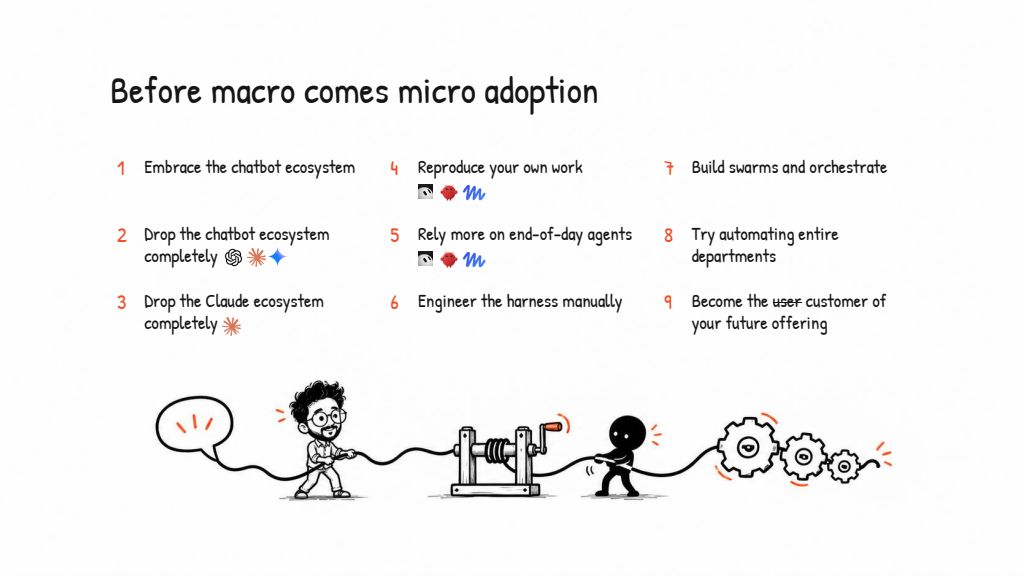
30 / 33Before macro comes micro adoption - 1. Embrace the chatbot ecosystem
- 2. Drop the chatbot ecosystem completely
- 3. Drop the Claude ecosystem completely
- 4. Reproduce your own work
- 5. Rely more on end-of-day agents
- 6. Engineer the harness manually
- 7. Build swarms and orchestrate
- 8. Try automating entire departments
- 9. Become the user customer of your future offering
What I say here
Before your company goes agentic, you do. Nine steps, and they are in this order for a reason.
Start with the chatbots. Then leave them. Rebuild your own work with agents, then swarms, then a department. By step nine you are your own first customer.
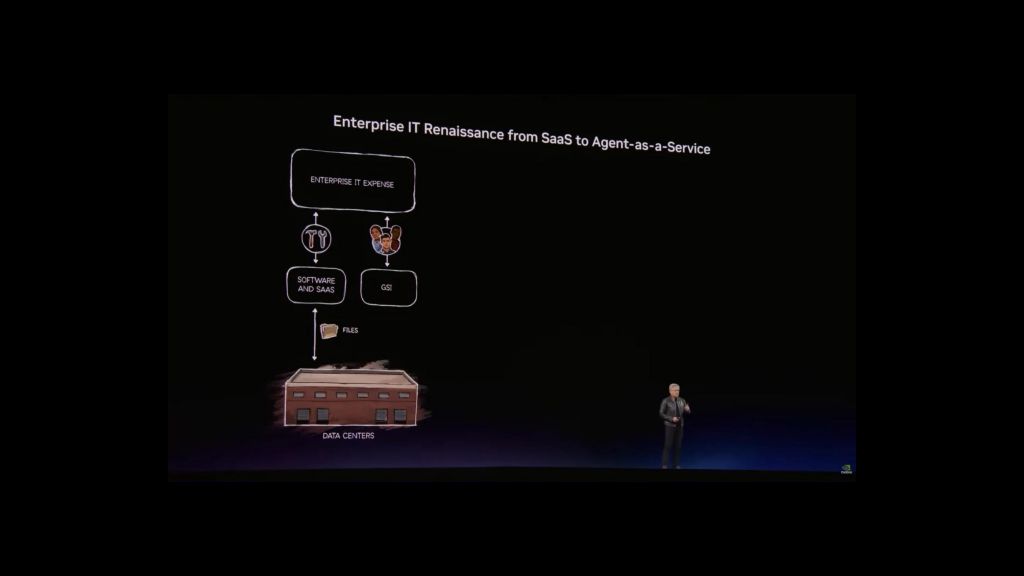
31 / 33Enterprise IT renaissance: from SaaS to Agent-as-a-Service - From an NVIDIA keynote: enterprise IT expense, software and SaaS, GSIs, files and data centres, redrawn around agents
What I say here
This is from an NVIDIA keynote. Enterprise IT, from SaaS to agent as a service. So it is not just me saying it.
The stack under enterprise spend is being redrawn. Where is your box on it?
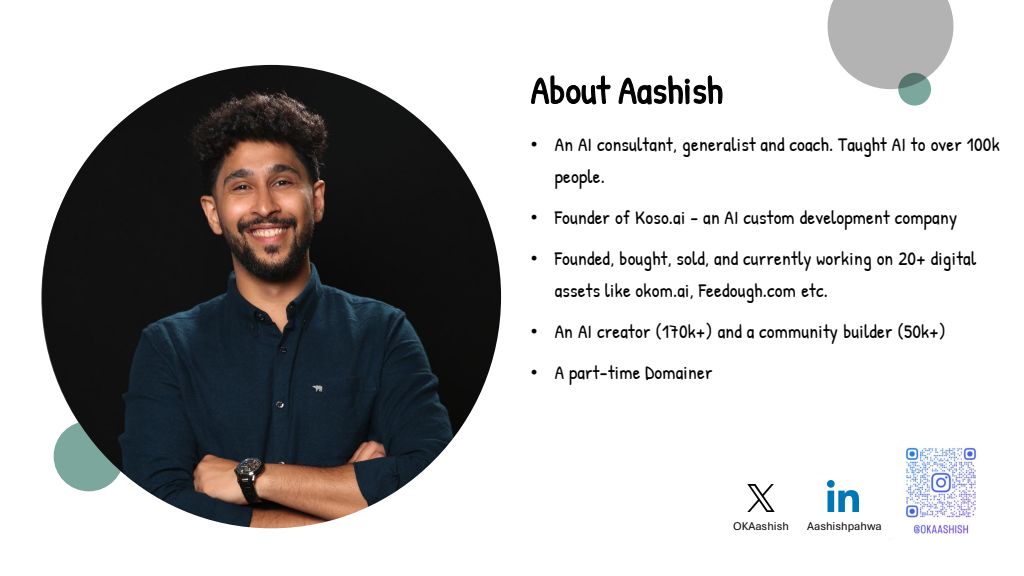
32 / 33About Aashish - An AI consultant, generalist and coach. Taught AI to over 100k people.
- Founder of Koso.ai, an AI custom development company
- Founded, bought, sold, and currently working on 20+ digital assets like okom.ai and Feedough.com
- An AI creator (170k+) and a community builder (50k+)
- A part-time domainer
What I say here
Quickly, who I am. I build custom AI at Koso. I teach it, a hundred thousand people so far. And I make videos about it.
Founded, bought and sold twenty odd digital assets. Feedough, okom.ai, and a few I will not admit to.
33 / 33Let's talk more - I run koso.ai
- X: OKAashish. LinkedIn: aashishpahwa. Instagram: okaashish
What I say here
That is the deck. Now the useful part. Ask me things.
I am okaashish everywhere, and I run koso.ai. Book a call if you want to build one of these.
/02
Questions
The AI here has read every slide and my notes, and it checks the web when a question needs it. Ask it what you would have asked me in the room.